Showing posts with label Melodrama. Show all posts

12 July 2012

Cocaine: One Man's Seduction

"We don't make love for a couple of days and you got me ready for the funny farm."
COCAINE: ONE MAN'S SEDUCTION
a made-for-tv movie from 1983
directed by Paul Wendkos
A cocaine melodrama about a suburban middle-class middle-aged real estate agent in his declining years who kicks his booze habit with some sweetass cocaine. James Spader is his teenaged son and Jeffrey Tambor is his friend who shares a coke history.
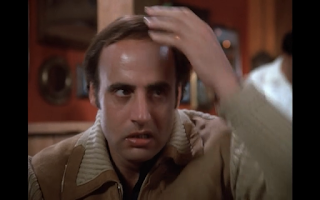
 
The coolest thing about this movie is it scissors reality into fantastically emotional and poignant melodramatic shapes. I think melodrama uses hyperreality to create an experience that by its intensity is meant to convey certain emotional realities, to "seek something in hyperbole which otherwise might not be reached," as Gass said. Sometimes when you see a movie about a situation it can be like, hard to feel what they feel, and I think melodramas search for ways to depict interior realities.
A funny personal story is I watched this movie thinking Karel Reisz had directed it, because I'd been considering watching a Reisz movie at the same time I was considering this movie. I probably would've even told someone Reisz directed this movie if I hadn't written this and gone to IMDb to fact check. Paul Wendkos directed this movie and apparently over a hundred other tv episodes and tv movies, along with what looks like a handful of theatrical releases. I feel like if they still made tv movies like this I might watch them. But it makes sense this was directed by a tv director, it felt like a tv movie if I'm being honest.
Boss: "Eddie, it's bleeding, your nose."
(Eddie wipes nose)
Boss: "I'm sure Eddie didn't realize --"
Eddie: "Hey! Don't tell me I didn't realize. It's infected. Anybody'll tell you that. Any doctor will tell you that. It could happen to anybody. (to clients) What the hell are you looking at?"
For a while Eddie feels like God in that way cocaine makes people feel like God, and I think the movie does a good job of capturing the Godlike feeling (i.e. there's a helicopter shot). At first it's increased energy and renewed belief in oneself etc., but of course it turns south, and when it goes south, it goes all the way south.
Eddie travels to his buddy's house for a promised prep-snort before a crucial business meeting (Eddie flushed his own ounce during a bathroom mishap!), but his buddy's lady relays news that the buddy was arrested and is jailbound and she asks Eddie to leave she wants to be alone but Eddie won't leave and Eddie charges into the place and becomes angry and physical and ransacks the place searching for cocaine oh buddy oh buddy.
Then, when he gets the cocaine (out of a trashcan -- p, thetic), shit hits the mother fucking fan. Eddie suffers a paranoid freakout that segues into a hospital-severe o.d.
This, understandably, shreds the souls of hotass young Spader and his movie mommy. In the end Eddie learns an easy lesson the hard way -- all you can do is accept that life gets a little crappier as you age and your family is stupid and you aren't the success you wanted to be.

I liked this movie, I can't tell if I'm making fun of it or not. I liked it. Nine thumbs up.

10 July 2012

Be Yourself! ('30)

"Say, if he can sue me for what I did to him in the cafe,
they can send me to the chair for what I'll do to him in the ring. Hohohoho. Ahahahaha."
BE YOURSELF!
a boxing melodrama musical comedy from 1930
directed by Thornton Freeland
A goodhearted and successful nightclub singer volunteers her lawyering younger brother as the boxing manager of her nightclub-regular alcoholic knuckleheaded crush.
The movie is their quest to transform him from the belly-up boozing loser he is today, into the world boxing champion they know he can be tomorrow. The multi-limbed movie throws constant entertainment punches. For example, Fannie Field (Fanny Brice) listens with her gal pals to her beau's bout on the radio at her club,
is pulled away for a musical number,
and returns to the dressing room to hear the end of the boxing match on the radio,
which is intercut with her personal victory in a fight in the dressing room.
The second film from director Thornton Freeland, who went on to direct 24 more movies before retiring in 1949. None of his movies are particularly famous. This is a rare screen presence for Broadway sensation Fanny Brice, who was the subject of the Barbra Streisand movie Funny Girl and its sequel Funny Lady.
The movie's boxing scenes are silly in a regular silly way. Boxing isn't taken very seriously.
The night club performances are silly in an awesome way.
One stand-out sequence involves a devil-on-stilts, a bunch of backup dancers, Fannie behind a towering podium,
and a little movie magic.
 
F. U. N. "Serious" obstacles, like alcoholism and boy stealing, aren't investigated or developed in a way that leads to revelation or insight; these things are temporary and included to keep things forward traveling and to give the protagonists more victories.
 
They're punctuations in the story, little cheap thrills meant to seduce an audience. This is around the beginning of the Great Depression. It's commonly accepted that people's lives were horrible and bleak enough off-screen at that time, and gloomy material wasn't necessary on-screen. Like, life was horrible, let it be great in one place: the silver screen. I like these movies not only because people wear sweaters with boats on them,
but also because they offer porthole views into the world of the 30s, their clubs and art,

child entertainers,
and this feeling that everything, all misery and everything else,
can be danced away.

06 July 2012

Cop Hater ('58)

"They found him laying there like garbage outside some crummy closed-up movie palace."
COP HATER
a crime film from 1958
directed by William Berke

Cop Hater is a make-believe police fantasy film from 1958, based on the samely-named Ed McBain novel from 1956, apparently based on the make-believe police procedural show Dragnet. Stuff like this I love -- a movie that's a depiction of an altered reality. A story about a dream.


"A cop was killed tonight, that's the megillah, and he was killed with a .45"

Loved the classy sleazoid vibe of this pulp melodrama trash-fest. I guess McBain knew the short route to realism was vices, fatal flaws, tragedy, and dreary sensationalism. The title -- Cop Hater -- bravo.


"Somewhere, in this weird wide wonderful city of ours, some crazy bird, with a -- kink in his brain, is oiling up his .45, for jungle hunting. His crazy brain wants cops. Cops. Cops."

A party checklist could be made for this movie: policemen, police station, world-weary old-timers, a youth gang, newly-wed officer, baby,
check out this baby doll used as real baby, creeeepy
collusions, a grumpy sexpot wife, a deaf and dumb girlfriend,
seriously, one cop's girlfriend is a cutie mute/deaf girl
heroine addiction ("all he cares about is the mainline"), alcoholics, journalists, undercover operations, police brutality, identity mixup, etc. 
modern science
"Well if it don't make sense there's no sense talking about it. I'll let ya know if it shapes."

The movie isn't a reflection of the real world, it's a magnification of a world created by popular culture. It's tons-of-fun bullshit, especially if you're into crime cinema's most romanticized symbols: babes and bullets.

When the movie was made William Berke was toward the end of his long directing career, which had begun in 1935 with a movie called Toll of the Desert. His best movie is a matter of esoteric debate, he never helmed a "classic," but his directing career spanned many years and included dozens of movies; 95 IMDb directing credits, ~20 of them tv credits, and earlier acting and writing credits.


I wonder what it felt like to see this movie in '58, I bet it was fun. The movie is a cheapo, the sound recording is tinny, and locations seem reused for budgetary reasons. The acting is wooden or theatrical, either method amplifying the absurdity of the dialogue. There's no reason for this movie to be someone's favorite. It doesn't add to the well from which it draws. But I think it's wonderfully giddy and entertaining. Who will carry it into the future, will it be carried into the future. It's sad and weird to think about this movie's future. Who will care about it, and who will see it. Who will know its name. 

In this violent scene a man's head is slammed against the floor
Cop Hater, I know and respect thee.

02 July 2012

The Good Heart (Dagur Kári)

I made my way to The Good Heart via Dagur Kári, being a fan of his 2003 movie Nói. He wrote and directed that one and wrote and directed this one. My reasons for watching the movie are similar to my reasons for watching Roadie, which I watched because I was a fan of Michael Cuesta's 2001 movie L.I.E. And, isn't the world tiny, The Good Heart reteams the duo of Paul Dano and Brian Cox, the dramatic center of L.I.E.

The man in the middle is the great-great(-great?) grandson of Jules Verne, he's trying to be a writer as well but it's a a hard shadow to stand in
The Good Heart creates a microcosm of special feelings from a NYC bar at the universe's center. Most dramatic action begins or ends here. I felt during this movie how I felt when I visited my grandparents when I was younger, that all answers and everything else were somewhere within the walls, and the antique feeling of the bar coupled with the desaturated colors enhanced this feeling.

I allowed the movie reality to replace my assumed reality. The movie rewarded me for this by behaving like a fantasy; it's the most romantic portrait of a bar I can think of, almost certainly the dreamiest depiction of small-business drudgery yet committed to cinema.

Um, that's a duck -- he's chasing after the duck, they're friends :)
The emotions come in swelling undulations. As Boudu Saved from Drowning demonstrated so long ago, the homeless make for terrific stories. In this movie Lucas (Paul Dano) is homeless when bar owner Jacques (Brian Cox) meets him in the hospital. Jacques has been hospitalized owing to his fourth or so heart-attack, and Lucas attempted suicide by wrist slashing. Funky couple? You bet.

The story from there is what you'd expect.

lol
Warm and gooey tragedy, almost candlelit. In addition to the great-great(-great?) grandson of Jules Verne, other lively bar regulars (Jacques business wisdom: no walk-ins allowed, and having more than 13 people in the bar is discouraged) include a chimney sweep, a garbage man, a male flower shop clerk, and others, all of them charming.

The movie's title refers to a 'good' heart and a good heart, the figurative and the literal. Like having heart by being a good person, and having a heart in your chest that literally goes thump-thump-thump. When you get it you got it.

18 June 2012

Roadie (2011)

The Blue Öyster Cult fires Jimmy (Ron Eldard), mid-40s, as their roadie. He returns to his mother's house in Queens, where he grew up. People from his teen years linger on: Randy Stevens (Bobby Cannavale), who used to bully Jimmy and call him "Testicles," inherited a car dealership and married Jimmy's ex-flame Nikki (Jill Hennessy), who took up songwriting ten years prior and performs in the local bar for a crowd of 30-40 people each Sunday.

Co-writer and director Michael Cuesta spends the movie's long beginning establishing and framing these particulars. To me it feels less like a person named Jimmy re-enters ordinary reality and deals with the agony of incomplete dreams, and more like a character named Jimmy written by some person and acted by some different person travels through a narrative that depicts these ideas. Like, I don't believe the movie for a second. Cuesta attempts to depict harsh realities (time lost, regret, squandered opportunity, irresponsibility, fading glory, etc) but makes such an effort to cram these within the narrative, and in such clear and shaped ways, that the script feels superimposed.

It's a style of moviemaking that Cuesta isn't alone in creating -- this feels philosophically related to the work of Thomas McCarthy (Win Win) and Miguel Arteta (Cedar Rapids). Basically these movies detail the highs and lows of middle-brow characters, whose lives are neither wacked-out disasters nor remarkable successes, and who struggle to carve out pieces of happiness for themselves each day. But these movies also not-so-secretly celebrate our resilient spirits and determination.

I don't mind a movie with a message, but I prefer movies that don't warp reality to make their messages, because when this happens the message loses its value when converted back to real life. Plus these characters feel so passive I almost blamed them and it's frustrating.

Cuesta's '01 movie L.I.E.,  a graceful and brave portrait of dark hearts, is one of my favorite American independent movies from the gritty era. The center of the movie was a cold truth that was larger than the movie.

Cuesta is still capable of going there, as demonstrated by the best moment in '05's Twelve and Holding, and the best sequence in Roadie. Jimmy, Randy, and Nikki party in a hotel room that's the same hotel they used for parties when they were teenagers. They come to let loose, drink a bunch of liquor, and snort a bunch of coke. They go off the rails, and Cuesta follows.
The sequence is not less dramatic than others in the movie. It culminates in raw-truth admissions and hurt feelings:
Randy acknowledges the sexual tension between Jimmy and Nikki. He makes a big show about putting Jimmy down. He tells Jimmy that Nikki gave him the nickname Testicles and she always thought Jimmy and his dreams were a joke. He tells Jimmy he doesn't believe things Jimmy has said about being the band's manager and writing songs. He thinks Jimmy is a "schlepper" and accuses Jimmy of seeing himself as superior for unwarranted reasons. Most of these things are truthbombs.
Jimmy tells Randy he's toured the world and lived for real the rock and roll lifestyle they sometimes pretend to have.
During this sequence there's a wild and untamed tension. I felt like I didn't know what was going to happen next, and I felt bad for everyone.

During this sequence Cuesta penetrates to sub-surface realities and offers doses of perspective in an organic and challenging fashion. It feels like people dealing with being themselves, while at so many other points in the movie it feels like characters dealing with a script. If the point of the movie is that life is ugly and messy and difficult and painful, then I think the movie should feel ugly and messy and difficult and painful, like it does in this hotel sequence.