laurence anyways -- part of me thinks it's so exceptional that it could be praised based "on principle." but that's like silly. xavier dolan throws a cinematic bash for his sweet laurence. i think the movie is a cinematic party and everyone's invited. i feel this movie confirms what i suspected, that dolan cares, his feelings are substantive, and i think accusations of self-indulgence are at this point unreasonable. dolan's emotional reach extends beyond the screen and into, at least, my heart. laurence anyways increased my sense of self. it made me feel less lonely. and in the evening of my viewing i felt sharply self-empowered, and during and after the movie i had fireworks in my soul. hope it sticks when it's released in the theaters. it could be cinema's ambassador.
post tenebras lux -- this girl runs through water puddles chasing cows and the sky darkens from deep purple to black and lightning cracks and mountains huddle in the background.
tchoupitoulas -- just thought "this movie is balzacian" and i think it is
bad fever -- movies like this will always be important, imo. ones that kind of strip things away. its ugly honesty, its secret tenderness. kentucker audley as eddie is like totally human and by the end of the movie you want things for him, like he's your dude, and i think it's amazing when movies do that.
dark horse -- my friends and i cheered for the cougar. i think we clapped for her and sometimes sighed and just got really into her. laughing thinking about her car and house. feel like solondz kind of mellowed his pessimism, 'cause this one's tough and sometimes mean and terrible, but i felt like he was saying "try harder," and i feel like if one sees that life is worth fighting for that's like, a good step forward.
the master -- i think a lot of us wanted pt to do something else. this movie was like flamboyantly formal. it's a formal exercise, sure. and we were like, what, we cried like toddlers. somehow this movie has struggled to align itself with values outside cinephilia. the scientology thing didn't stick. the best friends angle didn't ignite. post-war spiritual desolation, brand making, animalism, alcoholism, self-inquiry, magnetic personality -- none of it has really stuck out. but it's all there. in time it'll become more obvious that pt didn't let cinema down, we let pt down. only the movie matters. good movie. good job.
only the young -- i like felt like the movie was about me, you know. good job
blood of my blood -- don't want to forget how much i liked its handling of overlapping conversations/moments
open five 2 -- seems like kentucker audley really thought about what it'd feel like to watch this movie, which consideration seems like an advancement from like previous or other lowbudge movies. it's fluid. it's the new marker, that's all i mean
rust and bone -- it's so fun to remember and describe this movie
turn me on, dammit! -- kind of expected, right. a pretty, feeling, sexual-coming-of-age story. this one dialed me up.
perks of being a wallflower -- squeezing this one in 'cause it talked about depression and had rocky horror picture show reenactments. those things need movies. i don't understand like what happened with the aunt and i don't think that was necessary maybe. but, good movie.
the end
Showing posts with label 10s. Show all posts
Showing posts with label 10s. Show all posts
15 January 2013
21 December 2012
William Never Married
The sole line of writing I contributed to this Open Five 2 entry was a parenthetical caption that speculated on whether I just like any ol' movie with a dirty windshield. I'm also inclined to like movies with fireworks.
 William Never Married begins with fireworks, and then a medium shot of a person with fireworks behind her,
 and then a closeup of the person with fireworks behind her.
 (It was easy for me to double-check this sequence because, as of right now, the full feature is available online and for free.)
Fireworks strike me as excellent material for cinema, 'cause their size and color "work" visually, and 'cause they can connect a person with a reallife memory that's likely to be positive and special. So right away I liked William Never Married, directed, co-written, and co-edited by Christian Palmer, who also stars, because it began by gifting me with a cinematic treat. Sometimes you can watch an entire lowbudge movie and not receive a single cinematic treat.
The reasons I like dirty windshields are unrelated to the reasons I like fireworks, and it's their nonrelation that's important, vital -- these things feel like good launching points for discussing cinema and reality and the way reality interacts with cinema.
To summarize, basically, unrelated things (or dissimilar things, like reality and artificiality) can end up complimenting each other and achieve a cinematic harmony, if the person making the movie wants to do this.
Like many conversations about cinema, this one has precedent in a quote by Jean-Luc Godard, who said "the cinema is not an art which films life: the cinema is something between art and life. Unlike painting and literature, the cinema both gives to life and takes from it, and I try to render this concept in my films. Literature and painting both exist as art from the very start; the cinema doesn't."
Whether one wants to call cinema art, it's a thing someone has to create for it to exist. Cameras and editing and maybe other things are used to create cinema. Conversations about reality and artificiality in relation to cinema are sometimes kind of confusing, 'cause one sometimes feels that these lines are arbitrary, and ideas about "limited manipulation" and "artistic emphasis" can become fuzzy, and overwhelming, and sometimes the conversations are frustrating because a person can try very hard to steer the conversation one way or another, and anyway maybe sometimes one doesn't want to have the conversation. So instead of that conversation, I'll talk about William Never Married, while secretly talking about this. Or maybe I'm talking about this and secretly talking about William Never Married. Anyway,
by beginning with fireworks, I feel like Palmer began with specialness, and that specialness is related to consideration (if it's selected, which these fireworks were), and that cinema takes special consideration.
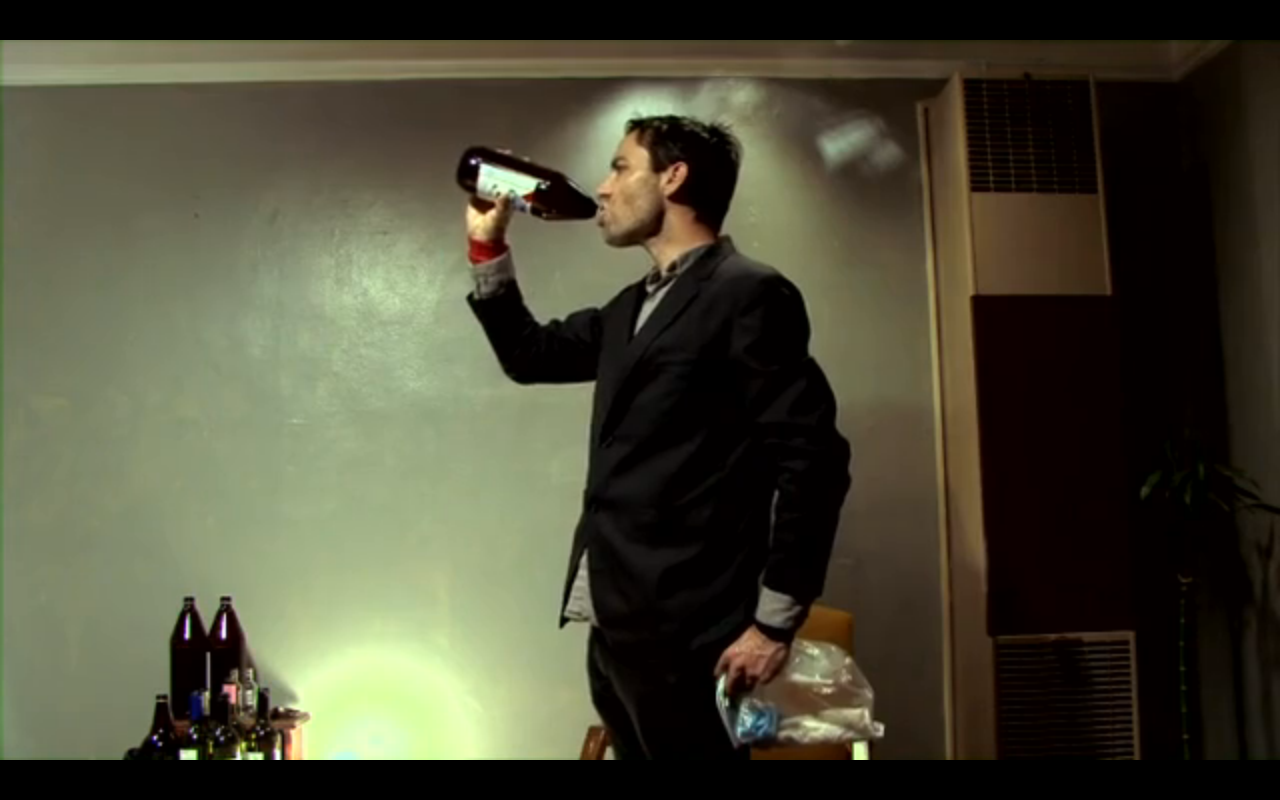
In this movie, which can lean toward the poetic (e.g. fireworks), the characters are the dirty windshields,
 the thing that might not exist in a movie that attempted to clean material in order to deliver it germ-free to the audience. The lead in William Never Married is a depressive alcoholic whose sufferings are sometimes external and always internal.
 The character's depression and alcoholism have the melodramatic gravity they do in real life -- they can seem ridiculous, unnecessary, too much. Obviously wrong. One sortof wishes he'd "snap out of it." I felt uncomfortable sometimes.
In this way, William Never Married has the open-eyes open-heart quality that I like in cinema. I like when a movie is faithful to its characters first, and I like when the cinematic machine is used to mine something out of the character, and help the audience discover the substance of the character.
 During a movie like this beautiful collisions can occur between cinema and its reality. A thing can be shown in a special way that enhances the emotional comprehension without subtracting from the reality of the moment, such as the above shot, a god's eye pov. Here the technique doesn't damage the sense of reality.
There's a funny thing about productions -- it seems like with lots of resources and time a moviemaker can go further in crafting reality, but one knows or senses the large apparatus controlling the reality, and with limited resources and time the reality can be automatic or pre-supposed, and one knows or senses the tininess of the apparatus.
However tiny the apparatus is, it exists, and why should it be disregarded, if it can't be dispensed with. Some lowbudge movies seems like they're saying "this was just happening and we stuck a camera there, believe it. BELIEVE IT." For example Snow on Tha Bluff, a movie I like for many reasons, forces a framing device that I feel kindof cheapens the movie, 'cause I don't understand why a moviemaker would have to insist that what's happening is reality (and like, if that's supposed to help you imagine the movie is reality, why use the imagination in such a limited and duplicitous way).
 Instead, it seems better to insist that the person in the movie is feeling this thing or that thing, and that what's happening on screen is the best possible representation of a multi-layered reality of living moments.
A moviemaker can't dig more truth out of reality, which just is what it is, but a moviemaker can add truths to reality, I think.


Fireworks strike me as excellent material for cinema, 'cause their size and color "work" visually, and 'cause they can connect a person with a reallife memory that's likely to be positive and special. So right away I liked William Never Married, directed, co-written, and co-edited by Christian Palmer, who also stars, because it began by gifting me with a cinematic treat. Sometimes you can watch an entire lowbudge movie and not receive a single cinematic treat.
The reasons I like dirty windshields are unrelated to the reasons I like fireworks, and it's their nonrelation that's important, vital -- these things feel like good launching points for discussing cinema and reality and the way reality interacts with cinema.
To summarize, basically, unrelated things (or dissimilar things, like reality and artificiality) can end up complimenting each other and achieve a cinematic harmony, if the person making the movie wants to do this.
Like many conversations about cinema, this one has precedent in a quote by Jean-Luc Godard, who said "the cinema is not an art which films life: the cinema is something between art and life. Unlike painting and literature, the cinema both gives to life and takes from it, and I try to render this concept in my films. Literature and painting both exist as art from the very start; the cinema doesn't."
Whether one wants to call cinema art, it's a thing someone has to create for it to exist. Cameras and editing and maybe other things are used to create cinema. Conversations about reality and artificiality in relation to cinema are sometimes kind of confusing, 'cause one sometimes feels that these lines are arbitrary, and ideas about "limited manipulation" and "artistic emphasis" can become fuzzy, and overwhelming, and sometimes the conversations are frustrating because a person can try very hard to steer the conversation one way or another, and anyway maybe sometimes one doesn't want to have the conversation. So instead of that conversation, I'll talk about William Never Married, while secretly talking about this. Or maybe I'm talking about this and secretly talking about William Never Married. Anyway,
by beginning with fireworks, I feel like Palmer began with specialness, and that specialness is related to consideration (if it's selected, which these fireworks were), and that cinema takes special consideration.
In this movie, which can lean toward the poetic (e.g. fireworks), the characters are the dirty windshields,

In this way, William Never Married has the open-eyes open-heart quality that I like in cinema. I like when a movie is faithful to its characters first, and I like when the cinematic machine is used to mine something out of the character, and help the audience discover the substance of the character.

There's a funny thing about productions -- it seems like with lots of resources and time a moviemaker can go further in crafting reality, but one knows or senses the large apparatus controlling the reality, and with limited resources and time the reality can be automatic or pre-supposed, and one knows or senses the tininess of the apparatus.
However tiny the apparatus is, it exists, and why should it be disregarded, if it can't be dispensed with. Some lowbudge movies seems like they're saying "this was just happening and we stuck a camera there, believe it. BELIEVE IT." For example Snow on Tha Bluff, a movie I like for many reasons, forces a framing device that I feel kindof cheapens the movie, 'cause I don't understand why a moviemaker would have to insist that what's happening is reality (and like, if that's supposed to help you imagine the movie is reality, why use the imagination in such a limited and duplicitous way).

A moviemaker can't dig more truth out of reality, which just is what it is, but a moviemaker can add truths to reality, I think.

20 December 2012
Open Five 2
Labels:
10s,
American Independent,
Kentucker Audley,
Online Release,
Open Five 2
 |
| (think I like any movie with a dirty windshield) |


"I don't always want to make films this insular. I realize that there's issues outside of myself. And, um. But. I think, that that stuff will come, and I'm not in a rush to change the subject, to change the world that I've spent a couple years trying to establish, and I'm not in a rush to create something else, or to get outside myself. But I will. But I don't think insularity cripples the films, and I don't think they come and go so quickly, I don't think that these films -- I think they'll be around."
03 November 2012
Dispatch from AFI: Post Tenebras Lux
Labels:
10s,
Art House,
Carlos Reygadas,
Festival,
Post Tenebras Lux
the greater los angeles area has over 17.9 million people, a stat which i think makes the area endlessly fascinating and surprising. one interesting city and an OK place to live i think.
but fact is, because we're all different from each other and live our lives in at least slightly different ways, there are 17.9 million+ great los angeles areas, because each person creates their own metropolitan area through personal experience and perspective.
carlos reygadas, director of post tenebras lux (after dark, light)(FYI), has proven in each of his four movies that the spectrum of human experiences exist within each person regardless of geographical location or network size.
each person, to the toppest highs to the lowest lows, contains the full ingredients. and only a moviemaker like reygadas, who seems to care in a deep and earnest way about each person he places in front of the camera, is able to make this point.
i feel like reygadas might possibly lol at the idea of a "supporting character," or in other words a person whose perspective is a narrative or structural obligation. i feel like reygadas wouldn't insert a character in order to insert a character. i feel like reygadas cares about his characters in a way that suggests a person who cares about people too much to reduce them to narrative ornamentation. he's a moviemaker who holds on characters for extended periods but with shots so cinematically hypnotic and captivating and compelling that his longest shots feel short. any cinephile in 2012 can tell you how rare that quality is. you don't hold long to hold long -- something lives in the duration of a shot, in pure duration (which itself is a symbol of the human condition), and reygadas, i feel, knows what lives in the light, in the shadows, in the space of time, and elsewhere.
he probably doesn't know, of course. but he's curious. and i think the curious are brave. i really do.
21 July 2012
The Body as Soul: Bruno Dumont's Hadewijch
Labels:
10s,
Art House,
Bruno Dumont,
Hadewijch,
Nunsploitation
Where did she come from, Julie Sokolowski? She plays Céline vel Hadewijch, the movie's lead. I can see her soul through her eyes, her face is an emotion.

When her face is absent, I think of seeing it.

I can't think of her 'neutral' expression, she seems always in some thought or feeling,

drawing some thing out of herself for the moment,

or searching for a thing,

or hiding,

or absorbing;

her face can crush me, I become destroyed with it,

because Céline's emotions become mine,

and I want so badly for her to have the good ones only.

But, life as it is, one takes the good one can get.


It's a romance story where the girl is unable to be with her love. Her father is a Professional Christian (minister), and her parents think she's home waiting for exam results. The audience knows of the tension between Céline and her father not because the movie stresses it through repetition, but because the only time Céline says a critical thing about a person is when she talks about her father ("jerk"), to her friend Yassine (Yassine Salime), whom she meets in a Paris cafe. At a concert along a river,

Yassine makes a move on Céline, before he knows better.


He likes her as a friend, but doesn't understand her all the way.

His brother Nassir (Karl Sarafidis), a devout Muslim, gets her.


Nassir has ideas about where Céline can direct her love for Christ. Though they practice different religions, they relate on mutual grounds of psycho-passion for God.

The movie makes the case that belief is a shared characteristic which becomes categorized by the particulars of religion.

This is Bruno Dumont's fifth movie, from 2009. I hadn't seen a movie of his since his debut, 1997's The Life of Jesus, a good movie, but I was amazed by the growth Dumont has made. He's a moviemaker who continues the exploration of the human soul through the art of cinema, and his Hadewijch has the soul-puncturing efficacy of honest and brave movies.

And I'm not referring to Dumont's bravery in confronting controversially extreme emotions -- that controversy will fade, and what lasts of that particular brand of bravery -- I'm referring to his cinematic quest to expose the interior truth of Céline. It's brave of a moviemaker to care about his lead so much that I'm overwhelmed by a desire to talk about the lead, instead of the moviemaker, and I seem unable to separate the emotions of the lead from the emotions of the movie. Dumont has made himself as invisible as possible; all his cinematic techniques are intended to focus the emotions of Céline. His technique burrows inward.

And by witnessing a movie burrow into itself, I begin to burrow into myself. Hadewijch is a movie I've carried in my thoughts (there are a surprising number of emotions and moments to recall, though the narrative feels 'loose'), and in my thoughts the movie has continued to grow in meaning and emotion.
14 July 2012
Aching Souls: Love Songs, Declaration of War, Tomboy
Labels:
00s,
10s,
Art House,
Céline Sciamma,
Christophe Honoré,
Declaration of War,
Love Songs,
Musical,
Romance,
Romantic,
Sexy,
Tomboy,
Valérie Donzelli

Christophe Honore's Love Songs is a dreamy light-kissed romantic musical tragic romance. Because it's French, you know the double-up on romance isn't an accident: when the movie begins Ismaël Bénoliel (Louis Garrel) is in a threesome relationship with two girls, Julie Pommeraye (Ludivine Sagnier) and Alice (Clotilde Hesme). Julie is his girlfriend, the threeway is their mutual desire.

I can't tell you what other French movie's middle-moment is similar to Love Song's without spoiling both movies, but I'll say this movie shares a desire with other movies to explore the emotional trajectory of a single character as the character's life passes through multiple events that could just as well be two or more separate movies.
 Love Songs investigates, for example, the role of one's partner's family in one's life when one's no longer partnered with the family, i.e. one's ex's family. When in a relationship, one's partner's family may come close to feeling like one's own, but if one wants to put distance between oneself and an ex, it may be necessary to distance oneself from the family, which might hurt the feelings of the family. In Love Songs, Julie 's family thinks of Ismaël as family, but as his life extends beyond his relationship with Julie, he comes to think of them less. "I already have a mother and father," he tells Julie's sister.
 Love Songs showcases emotional details with a graceful elegance that enriches feelings of romance.The narrative isn't flattened in order to untangle emotional complexities. Honoré is faithful to his characters, honors their complexities, and doesn't "fix" them, but simply follows and observes, with a dazzling and intelligent camera that helps sharpen their emotional experiences.
This narrative technique has always been a favorite of mine for the reason that I've never truly felt like I'm the leader of all my own life's circumstances, sometimes I feel the inflluence of forces like fate, chance, chaos, catastrophe, etc. The fact is, things occur in my life outside my ideal script.


Donzelli depicts realities of existence and being human, and how one's quest for love and happiness is sometimes sabotaged by outside forces. She suggests dedicated love has an immense power (Romeo and Juliet's love for their son is something brave and big), and says part of our happiness comes from a choice made about one's interpretation of circumstances.

Funny to think a lot of family movies are about kids struggling to like their parents or parents struggling to like their kids or otherwise many variations on unhealthy, damaged, dysfunctional, or broken families. But fatal sickness and hovering death can make these problems vanish, in life as in the movie. Or rather, the problems don't vanish, but there's no greater human problem than death.
Donzelli sneaks her trysts with cinema. As a smile can break a spell of sadness, so too the movie occasionally sparkles; because if the characters are not, cannot always be, sad and dull, it follows that sometimes the voice of cinema has to sing.


The underlined portion reads: "She is totally afraid of dogs no matter their size," and she was born November 12, 1980.


It makes sense that visuals would be important to a movie about gender identity. Sciamma tends to compose a shot to frame the human elements, and this emphasis over the purely aesthetic grants her movie a lens of empathy.

During the movie I thought a lot about what looking at people means; it was interesting to see Laure observe boys to learn their mannerisms in order to imitate them. She had a special eye, different from everyone else. I thought about how one watches other people in order to learn how to be a person.
Common to each of these three French movies is the idea that characters as the center of movies creates opportunity for anything to happen, and then anything that happens is meaningful and important and relevant. If the story is the focus, character details can be off-topic and irrelevant, but if the movie is stories happening to a person, with an emphasis on the person, it seems like really and truly anything can count. It feels like the freedom of existence, rather than the rules of storytelling.
18 June 2012
Roadie (2011)
Labels:
10s,
American Independent,
Melodrama,
Michael Cuesta,
Roadie

Co-writer and director Michael Cuesta spends the movie's long beginning establishing and framing these particulars. To me it feels less like a person named Jimmy re-enters ordinary reality and deals with the agony of incomplete dreams, and more like a character named Jimmy written by some person and acted by some different person travels through a narrative that depicts these ideas. Like, I don't believe the movie for a second. Cuesta attempts to depict harsh realities (time lost, regret, squandered opportunity, irresponsibility, fading glory, etc) but makes such an effort to cram these within the narrative, and in such clear and shaped ways, that the script feels superimposed.
It's a style of moviemaking that Cuesta isn't alone in creating -- this feels philosophically related to the work of Thomas McCarthy (Win Win) and Miguel Arteta (Cedar Rapids). Basically these movies detail the highs and lows of middle-brow characters, whose lives are neither wacked-out disasters nor remarkable successes, and who struggle to carve out pieces of happiness for themselves each day. But these movies also not-so-secretly celebrate our resilient spirits and determination.
I don't mind a movie with a message, but I prefer movies that don't warp reality to make their messages, because when this happens the message loses its value when converted back to real life. Plus these characters feel so passive I almost blamed them and it's frustrating.
Cuesta's '01 movie L.I.E., a graceful and brave portrait of dark hearts, is one of my favorite American independent movies from the gritty era. The center of the movie was a cold truth that was larger than the movie.
Cuesta is still capable of going there, as demonstrated by the best moment in '05's Twelve and Holding, and the best sequence in Roadie. Jimmy, Randy, and Nikki party in a hotel room that's the same hotel they used for parties when they were teenagers. They come to let loose, drink a bunch of liquor, and snort a bunch of coke. They go off the rails, and Cuesta follows.

 Randy acknowledges the sexual tension between Jimmy and Nikki. He makes a big show about putting Jimmy down. He tells Jimmy that Nikki gave him the nickname Testicles and she always thought Jimmy and his dreams were a joke. He tells Jimmy he doesn't believe things Jimmy has said about being the band's manager and writing songs. He thinks Jimmy is a "schlepper" and accuses Jimmy of seeing himself as superior for unwarranted reasons. Most of these things are truthbombs.
 During this sequence there's a wild and untamed tension. I felt like I didn't know what was going to happen next, and I felt bad for everyone.
During this sequence Cuesta penetrates to sub-surface realities and offers doses of perspective in an organic and challenging fashion. It feels like people dealing with being themselves, while at so many other points in the movie it feels like characters dealing with a script. If the point of the movie is that life is ugly and messy and difficult and painful, then I think the movie should feel ugly and messy and difficult and painful, like it does in this hotel sequence.
Subscribe to:
Posts (Atom)