Showing posts with label American Independent. Show all posts

21 December 2012

William Never Married

The sole line of writing I contributed to this Open Five 2 entry was a parenthetical caption that speculated on whether I just like any ol' movie with a dirty windshield. I'm also inclined to like movies with fireworks.
William Never Married begins with fireworks, and then a medium shot of a person with fireworks behind her,
and then a closeup of the person with fireworks behind her.
(It was easy for me to double-check this sequence because, as of right now, the full feature is available online and for free.)

Fireworks strike me as excellent material for cinema, 'cause their size and color "work" visually, and 'cause they can connect a person with a reallife memory that's likely to be positive and special. So right away I liked William Never Married, directed, co-written, and co-edited by Christian Palmer, who also stars, because it began by gifting me with a cinematic treat. Sometimes you can watch an entire lowbudge movie and not receive a single cinematic treat.

The reasons I like dirty windshields are unrelated to the reasons I like fireworks, and it's their nonrelation that's important, vital -- these things feel like good launching points for discussing cinema and reality and the way reality interacts with cinema.

To summarize, basically, unrelated things (or dissimilar things, like reality and artificiality) can end up complimenting each other and achieve a cinematic harmony, if the person making the movie wants to do this.

Like many conversations about cinema, this one has precedent in a quote by Jean-Luc Godard, who said "the cinema is not an art which films life: the cinema is something between art and life. Unlike painting and literature, the cinema both gives to life and takes from it, and I try to render this concept in my films. Literature and painting both exist as art from the very start; the cinema doesn't."

Whether one wants to call cinema art, it's a thing someone has to create for it to exist. Cameras and editing and maybe other things are used to create cinema. Conversations about reality and artificiality in relation to cinema are sometimes kind of confusing, 'cause one sometimes feels that these lines are arbitrary, and ideas about "limited manipulation" and "artistic emphasis" can become fuzzy, and overwhelming, and sometimes the conversations are frustrating because a person can try very hard to steer the conversation one way or another, and anyway maybe sometimes one doesn't want to have the conversation. So instead of that conversation, I'll talk about William Never Married, while secretly talking about this. Or maybe I'm talking about this and secretly talking about William Never Married. Anyway,

by beginning with fireworks, I feel like Palmer began with specialness, and that specialness is related to consideration (if it's selected, which these fireworks were), and that cinema takes special consideration.

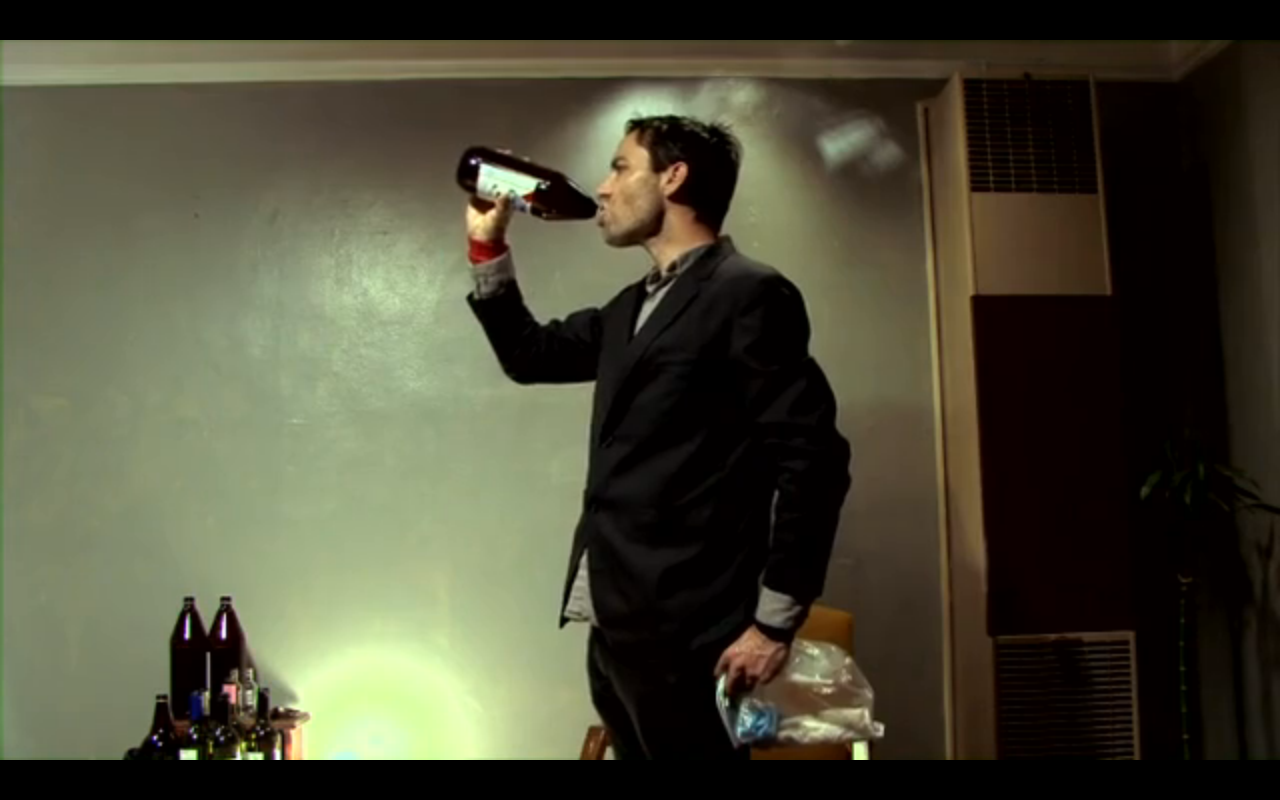
In this movie, which can lean toward the poetic (e.g. fireworks), the characters are the dirty windshields,
the thing that might not exist in a movie that attempted to clean material in order to deliver it germ-free to the audience. The lead in William Never Married is a depressive alcoholic whose sufferings are sometimes external and always internal.
The character's depression and alcoholism have the melodramatic gravity they do in real life -- they can seem ridiculous, unnecessary, too much. Obviously wrong. One sortof wishes he'd "snap out of it." I felt uncomfortable sometimes.

In this way, William Never Married has the open-eyes open-heart quality that I like in cinema. I like when a movie is faithful to its characters first, and I like when the cinematic machine is used to mine something out of the character, and help the audience discover the substance of the character.
During a movie like this beautiful collisions can occur between cinema and its reality. A thing can be shown in a special way that enhances the emotional comprehension without subtracting from the reality of the moment, such as the above shot, a god's eye pov. Here the technique doesn't damage the sense of reality.

There's a funny thing about productions -- it seems like with lots of resources and time a moviemaker can go further in crafting reality, but one knows or senses the large apparatus controlling the reality, and with limited resources and time the reality can be automatic or pre-supposed, and one knows or senses the tininess of the apparatus.

However tiny the apparatus is, it exists, and why should it be disregarded, if it can't be dispensed with. Some lowbudge movies seems like they're saying "this was just happening and we stuck a camera there, believe it. BELIEVE IT." For example Snow on Tha Bluff, a movie I like for many reasons, forces a framing device that I feel kindof cheapens the movie, 'cause I don't understand why a moviemaker would have to insist that what's happening is reality (and like, if that's supposed to help you imagine the movie is reality, why use the imagination in such a limited and duplicitous way).
Instead, it seems better to insist that the person in the movie is feeling this thing or that thing, and that what's happening on screen is the best possible representation of a multi-layered reality of living moments.

A moviemaker can't dig more truth out of reality, which just is what it is, but a moviemaker can add truths to reality, I think.

20 December 2012

Open Five 2

(think I like any movie with a dirty windshield)
"There is a degree to which I don't have older people in the movies because I don't want there to be an easy relation point for everyone. Like sorta, okay, so -- you're an older actor, if you see an older person in these movies you sort of see his perspective, or her perspective, and you think 'oh, I can find my way into this.' But if you don't have that, you're sort of left adrift. That's an interesting experience for me. You're sort of having to go through this world and not be -- like, you don't know anybody at the party, okay so, you have to go talk to somebody, that you don't feel comfortable with, or you have to just leave and go home. Both are reasonable responses, but I think that's an interesting kick off."
"As far as themes, I don't work with themes until the editing. And very loosely in the editing. I try to steer as clear from themes as possible. I don't think that they can be reduced to a theme. Um. I don't even know what the theme would be. I think they're about relationships, and trying to build a comprehensive view of my relationship and my friend's relationship -- not entirely comprehensive, but just trying to come at it from different angles."
"I don't always want to make films this insular. I realize that there's issues outside of myself. And, um. But. I think, that that stuff will come, and I'm not in a rush to change the subject, to change the world that I've spent a couple years trying to establish, and I'm not in a rush to create something else, or to get outside myself. But I will. But I don't think insularity cripples the films, and I don't think they come and go so quickly, I don't think that these films -- I think they'll be around."

(quotes from)

12 December 2012

St. Nick

St. Nick strikes me as a kind of folk movie, in that it draws from its own self, and seems faithful to itself  above all. Like, it sings a song of its own soul, with the voice of cinema.
The narrative evokes thoughts and feelings about self-searching and urgent discovery, and the speed of the movie is true to its characters, children (who are gifted with a mostly clockless existence), and its settings of fields and rundown homes and other outskirts of civilization.

It's sort of off the grid, minding its own, and unhurried by unseen troubles.
Is it a children's movie? In every wonderful way: its content is child friendly, its main characters are children, and most important to me, I felt like a child when I watched the movie. It has the sensitivity of a child and somehow -- a product of its art -- the movie vibrated with mystery and wonder, like the world does for a child.
The movie is fluent in the language of cinema. David Lowery (writer/director/editor) and dp Clay Liford demonstrate such good taste that was I reminded of the classic Hawks quotes about "three great scenes, no bad ones" and that a good director is "someone who doesn't annoy you."

St. Nick is a warm and lyrical movie that's essentially faultless.
A thing that's difficult to demonstrate in this format is Lowery's skill for cinematic grammar. The narrative is essentially a wallless series of drifting vignettes. Events occur late in the movie to help provide an overall context, but the bulk of the structure exists inter-sequence, emotion to emotion.
Cinema, from the inside out.

27 August 2012

The Brown Bunny

"i've never been a popular person, but it doesn't matter. i have everything in my life that i want. i'm not a walking publicity stunt. i'm not an anarchist, or bitter. i'm not trying to be subversive. i just try to remain unguarded, unprotected by fear, and agents and publicists, and i feel comfortable that way." vincent gallo
there's the story in the bell jar about the poet esther eats with at a fancy restaurant, where everyone but the poet is dressed a certain way, and the poet uses his hands to eat his salad, "one piece of lettuce at a time." and no one whispers or stares at him rudely. esther uses this story to communicate her belief that it's not one's knowledge of a table fork's intended use that's essential, but that the fork handler has confidence.

basically, i'm comparing vincent gallo with that poet in the restaurant. that's how i see him -- eating lettuce with his hands in a fancy restaurant.

a single restaurant couldn't be analogous to all of cinema, there'd have to be multiple restaurants, because it seems clear that not everyone wants the same cinematic food.
it's difficult to imagine a theater full of random people all liking and feeling positive about the brown bunny, based on people i know and movies that are popular. but because it doesn't appeal to everyone doesn't mean it wasn't made for everyone. this is important. gallo made his movie in a very specific way, but by all accounts (and i feel when watching the movie that) his intention was to make the movie for everyone. brown bunny doesn't operate on and isn't enriched by exclusionary cultural references or extraneous background knowledge.

the brown bunny exists as an unmappable curiosity, fine-tuned liked a person. its weight comes not from cinema, but from cinematic realness.
it wasn't a popular movie, with the audience or with critics. in the recent sight and sound poll, brown bunny received one vote: american moviemaker josh safdie (pleasure of being robbed), who also voted milestones, korine's julien donkey-boy, and a maurice pialat movie.

i feel deep and meaningful connections to the brown bunny, more than i do with the majority of movies i see (and i see so many movies) and i guess that means things that don't appeal to everyone have the same capacity for personal meaning as movies that appeal to a greater number of people.
two weeks ago or thereabouts, over a shared bottle of sake, i told my roommate a problem i had was i wanted to see a movie in the theater but there wasn't a movie in the theater i wanted to see. and again he became mad at me for not wanting to see the dark knight rises. it's his favorite routine. it's either the dark night rises or fincher's girl with the dragon tattoo or slumdog millionare or some other movie. i sense that he wants me to see these movies not because i might like them, but because he likes them so much.

amid my explanations for not wanting to see the dark knight rises, he accused me of not wanting to see the movie because it's popular. he was so off it startled me. we weren't having the same conversation. it took me a day and a half to figure out where the assumption came from. i realized there's this perception that the popularity of a movie has meaning -- that the numbers themselves have a meaning. this doesn't occur to me, not because i'm anti-numbers, but simply because numbers don't have the same meaning for me.

i like community, and i want it from cinema, but there are other things i want.

there are other things i want more.
based on my familiarity with the type of movie the dark knight rises is, and its maker, and based on its trailers, the movie isn't my bag. my specific bag. it's not the thing i die for. and i might like the movie, when and if i see it, i might be totally wrong. but nothing about it immediately sings to me, and don't we all follow the things that sing to us?

when a movie plays in the theater that sings to me, like solondz's dark horse, or hansen-løve's goodbye first love, the value isn't related to b.o. receipts or attendance. that stuff doesn't matter in an ultimate sense. and a lot of people talk about how it's the business end and a lot of people talk about how it does matter, but the truth comes to people when they sit alone in the theater and experience the movie.

only the movie matters.

while having domestic squabbles with the local multiplex i can sometimes forget there are these really wonderful american movies, and i think that's because some of the most wonderful don't play in multiplexes. many american movies i think are really wonderful aren't popular, for one reason or another, and by popular i mean they don't get mentioned in glossy magazines or chatted about too much on television and people don't go to see them and things like that.

i don't at all think the pure fact of them being underseen or unappreciated makes them important or unimportant, culturally or otherwise. that's like thinking the person who's talking the loudest or whispering the quietest has the most valid opinion by virtue of their speaking volume.

this doesn't apply strictly to independents either. when five-year engagement and the avengers were in the theater at the same time i asked my friend, who's a big alison brie fan, if the friend had seen five-year engagement, in which the supporting actors alison brie and chris pratt outperform the movie's leads, in my opinion. my friend told me he hadn't seen five-year engagement, that he doesn't go to the theater often, and that he chose to see the avengers because it was the more "culturally important" movie. well, i remember alison brier's wedding speech in five-year engagement better than i remember anything from the avengers. i took more from five-year engagement than the avengers. facts. but i don't blame my friend, i think the summer's first blockbuster, by a talented moviemaker with an exciting and huge cast of people, has many reasons for being seen, and i think a lot of blockbusters offer tremendous riches. prometheus was a pot of gold. abe lincoln vamp hunter had a lengthy action sequence that took place within, and used as weapons, stampeding horses, in 3d. snow white and the huntsman doesn't just have a magical godlike white unicorn that reigns over a lushly fantastical forest specialworld, the movie also uses this unicorn creature for a major dramatic beat. you can't not make this stuff up. skipping the dark knight rises i take the risk of missing riches. but you can't see everything, right, so we each make these little judgments about how we're going to spend our time based on the information we have about the thing and about ourselves.

we follow what sings to us. the voice that sings to me is weird and not the same voice everyone else hears, and sometimes i hate it for that, tell you the truth. and then in stronger moments i know and believe that if others aren't hearing it, i have more personal responsibility about remembering its song.
i'm arguing with imaginary people.

gallo, right, the brown bunny, right. right right right.

gallo does despair, as he does all things, without the traditional accompaniment of self-pity and self-consciousness. he doesn't apologize for having emotions.

the twisted confidence of his misery makes it a mini-miracle. if you've ever been around a person or people and had a bad feeling, and apologized to the person or people for having that bad feeling, there's a strength to be acquired through gallo and his art.
the brown bunny is about bud clay (vincent gallo) feeling miserable while driving across america to los angeles. and i think the movie, by its patience and focus, captures many shades of misery that are important.

both this movie and buffalo 66 have a lead collapsing inward on a very specific feeling.

until the movie's end one might not identify the brown bunny's central feeling as a specific emotion, (a large number of people would describe the movie through their own emotion, boredom,) but the attentive viewer senses an emotion hovering outside frame.

and car trips in general and the specific shots of this trip engender complex feelings about traveling -- the literal experience of traveling, reasons for traveling, feelings stirred by traveling, memories of travel, etc.

over backstreets, passing white-shingled two-stories in the middle of bug-splatters and gas stations and highways and days turned to nights, one senses a feeling chases bud, and one senses a feeling bud chases.
the first spoken word, "hi," comes at 6:27. bud to the country girl.

whom he ditches, promoting a feeling other than misery, or at least a compound misery. something like anger, disapproval, objection.

bud's misery takes the shape of its environment.

sometimes the movie doesn't feel miserable.

things other than misery take place.

i think the movie is actually a quiet war against misery.
or at least an investigation into misery.

its despair has a confessional tone that lends it a sense of earnestness. bud, a victim of tragedy, victimizes others, creating new tragedies. he's stuck in the cycle of humanness that pains him. he buzzes with pure and innocent fear. one notices his downcast eyes. his short replies. (his conversational goal seems to be to speak as little as possible without appearing rude.)

the divergent emotional textures have roughly each the same value in an eventless and drifting narrative. gallo doesn't emphasize emotions, doesn't suggest one is more important or greater than the other. this indifference is the indifference of a reality beyond the camera.
the movie makes me feel tender. i want to take care of buddy. didn't i begin this piece by defending buddy, by rooting for him? the movie draws it out of me, triggers my instincts to protect the weak. and that's because buddy's imperfections are as clear as his humanness and his frailty.

and i feel for him. for 93 beautiful minutes.

19 July 2012

Punching the Clown

Faced with several attractive possibilities for Netflix streaming, but overloaded on conflicting reasons for watching each one, I instead decided to watch a completely random movie I'd never heard of and knew nothing about. Typical to this situation, the Netflix image for the movie was a deciding factor:
The randomness of my choice, as opposed to the deliberateness of selecting one 'for my mood' or based on expectations, combined with the interesting poster (complete with laurels), and the positivity expressed by the swath of reviews I sampled, compelled me to watch Punching the Clown. Sometimes this method burns me and wastes my time, but I was lucky enough this time that it paid off.

Henry Phillips plays a fictional version of himself in a movie he co-wrote with director Gregori Viens. Henry is a comedian/musician large enough to have his name listed in Wikipedia, and small enough that the link doesn't lead to a page (red font = no link):
and that seems like a pretty good introduction to Henry. In the movie he's decided to give his industry career a chance to blossom by moving to LA and sleeping on his brother's couch. His brother, Matt (Matthew Walker), is an actor who, when not auditioning for Hot Pocket commercials, dresses as Batman for children's parties.
Not actually a photo of Matt, this is Henry in Matt's costume. Matt is a balding redhead with a goatee and jangly teeth (I assume that's how he likes to be described)

Matt: Carrie left me.
Henry: Aw shit man. Just like that huh?
Matt: Well we had a pretty big fight, and I'll spare you all the gory details, but I thought it would be a good idea to make up, so I sent her a singing telegram. Then she fucked the singing telegram guy.

The movie does a good job of rerouting typical situations into humorous variants. The narrative works by surprise, coincidence, misunderstanding, etc punchline betrayals of audience expectations. His lyrical humor functions this way as well, by employing creative wordplay; because of this, his songs work best the first time you hear them (I wonder if the movie would be like that too, cinematically it's unimpressive).
The movie's LA feels unprocessed and realistic (it's shot 'documentary style'). There's often a satirical view of LA milieu and its tendency for small-talk charged with business overtones. Other LA topics explored are personal voice vs marketing image, power vs perception of power, public appearances vs reality, etc social dimensions common to the entertainment industry.

A thing I liked about Punching the Clown is Henry doesn't possess an LA personality. Henry seems genuinely unfazed by the gloss and glamor of the city, uninterested in adapting to its business models. He hopes to remain himself and obtain the modest goal of financial success. In this way the movie is about the enduring artistic struggle to retain one's integrity and intentions in the business of art. This makes the movie the least-LA LA movie I've seen in a long, long time.

I don't think Henry places himself above LA, I think he's likable for his skill at deflating the ego of LA while cracking into his own persona. It's not at all a story about a rise to success, or even overlooked genius. Just some crummy and relatable semi-miserableness. He pokes fun at his plight by performing a blues song that's about being out of blues, because his life isn't so bad. The movie's dry humor compliments its vague dreariness, and it's consistently funny and interesting.

18 July 2012

Little Fugitive ('53)

Funny that this movie, which I'd never heard of until yesterday, is in the National Film Registry, and famous for being the movie François Truffaut named as inspiration for The 400 Blows, saying "Our new wave would never have come into being if it hadn’t been for the young American Morris Engel, who showed us the way to independent film production with his fine movie Little Fugitive."
Little Fugitive, through non-professional child actors, a handheld 35mm camera, location shooting, and hundreds of clueless extras, captures the feeling of being a young boy from Brooklyn visiting Coney Island in 1953. The film is as light as the day of a child, eschewing adult world responsibilities, problems, neuroses, etc.
The narrative pivots on a case of mistaken homicide: the slightly-older boys execute a ketchup-blood-based prank that convinces young and clingy Joey he's shot and killed his slightly-older brother.
And then, true to both the movie's naturalistic style and its boyhood perspective, when Joey flees (aka goes on the lam) to Coney Island, he spends his time tossing baseballs at milk bottles, riding the carousel (felt like the whole carousel ride was included), collecting bottles for nickels he uses to ride ponies, and in various other ways behaves like a normal child.
 During this trip, two peripheral characters are introduced -- one a small boy who teaches Joey about collecting bottles, and the man who runs the pony business. I can't tell you a thing about these peripheral characters, because Joey doesn't take the time to learn about them, because he's a kid, and for likewise reasons they don't volunteer their life stories.
I never felt afraid for Joey, whether because of assumptions about a safer 50s America, because he's only gone for one day, or because he doesn't seem too worried himself. There's the feeling that he's decided to live and spend the rest of his life on Coney Island, a place of endless pleasures.
I liked this movie so much. It reminded me of a kid's fantasy movie crossed with a 50s Japanese melodrama crossed with a documentary. Still photographers by trade, the moviemakers search out delightful details from Joey's journey, and the naturalistic style gifts the film with a sense of life and breathe. This doesn't feel like a scripted recreation of this life, it feels like an encounter with the real thing.
Basically, the whole movie is off the rails, but in the meandering readworld way of childhood adventure.

13 July 2012

Party Girl ('95)

"We still have to hang that piñata, and make the hash brownies."
PARTY GIRL
an independent party comedy drama from 1995
directed by Daisy von Scherler Mayer
This is the first shot of a person in Party Girl, from a tracking shot up a staircase during credits. And the first joke Mary (Parker Posey) makes is calling dollars "pesos." To say I liked this movie right away is an understatement.
Party Girl has lots of personality, style, and verve, lots of great superficiality, and executes these characteristics in a way I think reflects realworld surfaces (the inventorying of which modern literature and movies continue). The glossy, shiny parts of Mary's world stand out, but because she's human and possesses a soul and all that, it's important to explore the nourishment of her external existence. The movie suggests her impulsive party personality is rewarded with chill adventures, good times, sweet parties, mad hookups, crazy drugs, etc, but it doesn't say why she needs these things in her life. I submit that their usefulness is obvious, and that she needs them 'cause the qualities are demanded by the social sphere in which she thrives.
 And, I don't know, who can't relate to that. Who doesn't perform a thing or two for the sake of advancement in the world in which they are immersed, whether it be family life or careerism or hobbies or whatever.
If anything, what's outdated is the way the movie almost attempts to redeem Mary with her burgeoning interest in library science. I say "almost" because how seriously can you take a narrative about a party girl discovering a submerged desire to become a librarian -- the movie has its cake and puts its piece of cake in its pants and sits down. The movie suggests a party lifestyle is one of diminishing returns, and one without meaning, but I submit this describes life in general, and that the substance of life and existence is completely valid itself. Mary's problem is twofold: she lacks money, and she isn't all the way committed to her lifestyle. Perhaps it's better she discovered a formative interest, in order that she may soon confront the strict and patterned formulas of thought inherent to the library sciences. If you don't think that's a reality of library science, don't be silly -- I ask you, where don't these things exist?
I'm being so serious! Do you think I'm partially compelled to seriousness because I want to impart on you my serious feelings about enjoying the hell out of this movie?! It's a great NYC movie: all these eccentric personalities collide for explosively hilarious anecdotes. During this movie I thought about how all the supposedly airhead party characters are interested in books and music and culture, and I thought about how those things could become important to someone living a fast and urban lifestyle. It's funny because in one way the things seem to add to their lives, and in another way the things seem to substitute for an inner life. Like, they hope figuring out music or books or movies or whatever is as good as figuring out themselves.
Probs one of my fav sequences was Mary revisiting her falafel-street-vendor crush (who won't date her because he doesn't want to be her cheap fantasy "vacation") in a series of different awesome fuckme outfits.
It's like, obviously each outfit has a different meaning, why else would she keep trying different ones?? The outfit the dude falls for is her librarian one -- they hook up in the romantic poetry section of the library, when he visits to find some books to learn how to become a teacher in America, which is what he was (a teacher) in the place he's from which is Lebanon.
There's a party freakout scene that's pretty damn good. The party's theme seems to be general Asia. While dancing with a gem bindi but in a Middle Eastern way, Mary starts falling down and people have to hold her up and I think say things to calm her, I don't really remember. Seems like I broke the law of movies, which is to observe, and obeyed the law of parties, which is to let each person party how they see fit.
Party Girl was directed by Daisy von Scherler Mayer. It seems like fucked up shit that Mayer made this movie yet doesn't have a badass movie career. She's directing tv now, are you kidding me? Look, I'm not knocking tv, I haven't seen the tv stuff she's made, except maybe the Mad Men episode I didn't really look into it, but the point is Mayer, based on this movie alone, has a voice, a vision, and talent. And all of these things are rare and valuable, and if a person has them they're worth developing. Maybe it's some gender inequality, I don't know, I keep thinking about Noah Baumbach's Highball, which is a movie that's inferior to Party Girl in every way of which I can conceive. To elaborate, Baumach's first three movies, including the Criterion-released Kicking and Screaming, and Mr. Jealousy, are inferior to Party Girl. I say that as a fan of those movies and Baumbach in general. To be fair, there were a lot of other contemporary NYC moviemakers, and not all of them did as well as Baumach, regardless of gender, he shouldn't have been singled out by me, oops, he probably has a special quality, his movies are special, etc. But to stick to my point: Daisy von Scherler Mayer!
I feel insane right now. Am I being insane? I wrote this review stream-of-conscious. The movie deserved it. (Tell you the truth, I consulted and paraphrased the Paul Bowles novel The Sheltering Sky for an earlier sentence, because it felt relevant, and he was such a good writer :)