Showing posts with label 90s. Show all posts

13 July 2012

Party Girl ('95)

"We still have to hang that piƱata, and make the hash brownies."
PARTY GIRL
an independent party comedy drama from 1995
directed by Daisy von Scherler Mayer
This is the first shot of a person in Party Girl, from a tracking shot up a staircase during credits. And the first joke Mary (Parker Posey) makes is calling dollars "pesos." To say I liked this movie right away is an understatement.
Party Girl has lots of personality, style, and verve, lots of great superficiality, and executes these characteristics in a way I think reflects realworld surfaces (the inventorying of which modern literature and movies continue). The glossy, shiny parts of Mary's world stand out, but because she's human and possesses a soul and all that, it's important to explore the nourishment of her external existence. The movie suggests her impulsive party personality is rewarded with chill adventures, good times, sweet parties, mad hookups, crazy drugs, etc, but it doesn't say why she needs these things in her life. I submit that their usefulness is obvious, and that she needs them 'cause the qualities are demanded by the social sphere in which she thrives.
 And, I don't know, who can't relate to that. Who doesn't perform a thing or two for the sake of advancement in the world in which they are immersed, whether it be family life or careerism or hobbies or whatever.
If anything, what's outdated is the way the movie almost attempts to redeem Mary with her burgeoning interest in library science. I say "almost" because how seriously can you take a narrative about a party girl discovering a submerged desire to become a librarian -- the movie has its cake and puts its piece of cake in its pants and sits down. The movie suggests a party lifestyle is one of diminishing returns, and one without meaning, but I submit this describes life in general, and that the substance of life and existence is completely valid itself. Mary's problem is twofold: she lacks money, and she isn't all the way committed to her lifestyle. Perhaps it's better she discovered a formative interest, in order that she may soon confront the strict and patterned formulas of thought inherent to the library sciences. If you don't think that's a reality of library science, don't be silly -- I ask you, where don't these things exist?
I'm being so serious! Do you think I'm partially compelled to seriousness because I want to impart on you my serious feelings about enjoying the hell out of this movie?! It's a great NYC movie: all these eccentric personalities collide for explosively hilarious anecdotes. During this movie I thought about how all the supposedly airhead party characters are interested in books and music and culture, and I thought about how those things could become important to someone living a fast and urban lifestyle. It's funny because in one way the things seem to add to their lives, and in another way the things seem to substitute for an inner life. Like, they hope figuring out music or books or movies or whatever is as good as figuring out themselves.
Probs one of my fav sequences was Mary revisiting her falafel-street-vendor crush (who won't date her because he doesn't want to be her cheap fantasy "vacation") in a series of different awesome fuckme outfits.
It's like, obviously each outfit has a different meaning, why else would she keep trying different ones?? The outfit the dude falls for is her librarian one -- they hook up in the romantic poetry section of the library, when he visits to find some books to learn how to become a teacher in America, which is what he was (a teacher) in the place he's from which is Lebanon.
There's a party freakout scene that's pretty damn good. The party's theme seems to be general Asia. While dancing with a gem bindi but in a Middle Eastern way, Mary starts falling down and people have to hold her up and I think say things to calm her, I don't really remember. Seems like I broke the law of movies, which is to observe, and obeyed the law of parties, which is to let each person party how they see fit.
Party Girl was directed by Daisy von Scherler Mayer. It seems like fucked up shit that Mayer made this movie yet doesn't have a badass movie career. She's directing tv now, are you kidding me? Look, I'm not knocking tv, I haven't seen the tv stuff she's made, except maybe the Mad Men episode I didn't really look into it, but the point is Mayer, based on this movie alone, has a voice, a vision, and talent. And all of these things are rare and valuable, and if a person has them they're worth developing. Maybe it's some gender inequality, I don't know, I keep thinking about Noah Baumbach's Highball, which is a movie that's inferior to Party Girl in every way of which I can conceive. To elaborate, Baumach's first three movies, including the Criterion-released Kicking and Screaming, and Mr. Jealousy, are inferior to Party Girl. I say that as a fan of those movies and Baumbach in general. To be fair, there were a lot of other contemporary NYC moviemakers, and not all of them did as well as Baumach, regardless of gender, he shouldn't have been singled out by me, oops, he probably has a special quality, his movies are special, etc. But to stick to my point: Daisy von Scherler Mayer!
I feel insane right now. Am I being insane? I wrote this review stream-of-conscious. The movie deserved it. (Tell you the truth, I consulted and paraphrased the Paul Bowles novel The Sheltering Sky for an earlier sentence, because it felt relevant, and he was such a good writer :)

10 June 2012

The Faculty ('98)

THIS SECTION IS TOTALLY SKIPPABLE/PERSONAL SHIT BARELY RELATED TO THE MOVIE JESUS CHRIST

The Faculty, I'd never seen the The Faculty. 

It rests at a funny crossroads in my cinephilic journey. In 1998 I hadn't yet transitioned from late-night HBO and genre movies to 'serious' movies. Around this time I ate up horror movies, and around this time teenager horror movies were the rage -- Scream, I Know What You Did Last Summer, Disturbing Behavior, Urban Legend, um, Scream 2, I Still Know What You Did Last Summer, um, The Blair Witch Project, Scream 3, um, Final Destination, um, Jeepers Creepers, things like that. But somehow I missed The Faculty.

Robert Rodriguez is a moviemaker I understood to be some kind of notable moviemaker and I watched his movies when I became fanatic about movies. I watched El Mariachi and Desperado and From Dusk 'Til Dawn. I thought he was fun but I didn't get it. I really didn't get it. I thought because he was fun he wasn't serious. I bought his movies and subsequently sold them because I thought they didn't belong in a serious movie collection. I don't own any of his movies currently, and only recently have I returned to him.

And now I understand the intelligence and dedication it takes to make a fun movie. I get it now. The dude is a badass. I get it.

THIS SECTION DEALS WITH THE MOVIE CALLED THE FACULTY AND ITS DIRECTOR ROBERT RODRIGUEZ
The Faculty peels off the starting line with atmosphere and verve. Some pre-title mayhem.

Post-title Rodriguez introduces each high school character with a little moment that says a thing about them, so we know Zeke Tyler (Josh Hartnett) is the badass rebel, Casey Connor (Elijah Wood) is the weakling dweeb, etc. Their names appear on the screen:
Strange how the character credit creates a distance between the actor and his character. It's a slick trick, I think. For the viewer in that moment there's only Casey Connor; maybe outside the movie there's an Elijah Wood, maybe.

Rodriguez doesn't sweat the space between reality and cinema. His movies, at their best, are completely unshackled and pregnant with limitless possibility. He's the master of a movie world and introduces characters like this because he knows they're in a movie and doesn't pretend otherwise -- think of how obvious this is and think too about how many directors want to disguise the artificial aspects of moviemaking. So you believe in the movie or whatever.

Rodriguez doesn't care if you believe it, he has another plan. He makes his movies too large to forget. It's a whole other way of looking at movies, and Rodriguez's commitment to the angle is total and unwavering.

Why are fireworks going off during a high school football game and why do they sync with dramatic beats? The answer is fuck you.
Rodriguez knows how to make an image stick. He knows how to captivate and arrest.

It's a bummer that, after introductions, brakes are applied for character development, plot exposition, and other transitional elements. I'd say the movie comes to a flat-out stop when the cops are called in and Casey attempts to convince them he found a dead teacher in the staff closet but they don't believe him and his parents ask if he's on drugs and things like that. These moments appease the laws of reality, viz., they're unnecessary. And boring. Reality? AHAHAHA.

I'd about written off the movie up until the moment Zeke breaks off the knife part of a paper cutter
uses it to slice off the fingers of Prof. Edward Furlong (Jon Stewart)
stabs him in the eye with a homemade-drugs-filled ballpoint pen
and Prof. Furlong's fingers crawl over the floor.

This is the moment when the beast of cinema breaks free, and it pretty much reigns through the remainder of the movie. Seriously, a bunch of cool things happen. I'm restraining myself from posting screencaps of all of them because a) there are so many b) it would give all the cool things away, and maybe you haven't seen this movie before.

The scene a little after the Prof. Furlong scene echoes a famous scene from John Carpenter's The Thing and gives it a splash of social commentary -- the teenagers must take Zeke's homemade drug to prove they're normal.
The outrageousness is played straight-facedly.
 It kind of feels like what it's like to take drugs among teenage friends.
Maybe there are too many giggles, maybe giggles are a cheap way of expressing a character is high. Maybe not. Giggles happen.
 It is a funny situation, after all.

The way Rodriguez inserts the dramatic beats into this scene, and raises the tension, and treats it seriously... I don't know, this scene says so much about him as a moviemaker.

The movie's ending cashes in on the earlier character development. There's a nice and tidy message that's sort of like Invasion of the Body Snatchers, which the movie references multiple times, but with a maraschino cherry topping. It's simple: be a badass, and like fuck everyone else.

It's cool. The movie and Rodriguez are of one mind. The movie asks you to think a little more about the characters: Casey Connor is the weakling dweeb, sure. But what else could he be.

A cover of David Bowie's Changes plays over the closing credits.

14 May 2012

Hong Sangsoo's The Day the Pig Fell into the Well

It's a bad day when your pig falls into the well.

The Day the Pig Fell into the Well is the title of a John Cheever story and the name of Hong Sangsoo's first movie, from 1996, when the writer/director was 36 years old.

Welcome to the world of Hong Sangsoo.
While watching the movie I noticed it's simultaneously true that every shot feels 'real' and 'natural' while there isn't a bad shot in the movie.

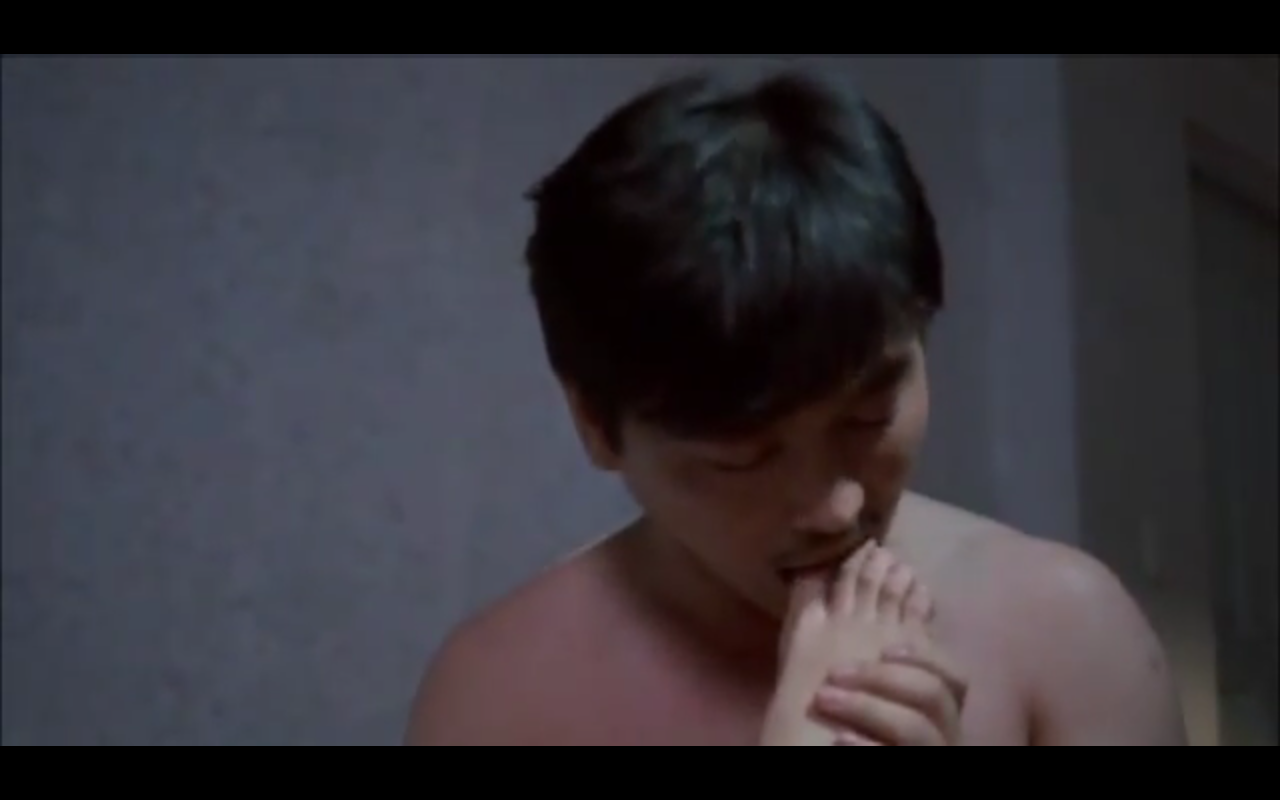
There's a precision to Sangsoo's realism that makes him unique among the international moviemaking community. He provokes the sensation of reality in the minds and hearts of his audience. One notices while watching his movies that feelings and moods typically skipped or glossed over are given narrative attention. Most notably and remarked upon, Sangsoo depicts boredom and anxiety. Sometimes in his movies the significance of a moment is a thing 'not' occurring, usually because a person is unsure about what to do, or a thing has not yet happened. Or maybe the two people aren't in the same emotional place at the right time and they need to get there or go somewhere else.
In this early movie Sangsoo intercuts scenes with a variety of setups, unlike recent movies and their frequent deployment of long takes (and a snap-zoom technique). He takes stylistic liberties -- hard cuts, leaps in time, juxtaposing edits, etc. -- but never to the disservice of his characters' emotional continuity.

He refuses to lie about his characters, who are always flawed and humanly imperfect. They tend to be emotionally self-protective, moderately selfish, quietly insecure, heavy drinkers, sexual scoundrels, subtly competitive, and/or hosts to a mess of anxieties.

A strength of his is depictions of struggle with self, as it overlaps with others' struggles with self, and how struggles accumulate and bulge through social collisions.

It's all right here in the beginning.
Perhaps because My Man Godfrey was on my mind, it occurred to me while watching this movie that Sangsoo makes 'existential screwball comedies.' Bingo?

He does that, but also more. I've not yet encountered a critic capable of whittling Sangsoo's art down to an epithet. The nature of his work resists it. There will forever be attempts to squeeze his expansive art into a few short words, great and accurate attempts like 'existential screwball comedies,' but it'll never work.


I remember a dinner scene from my life: being asked by one friend to describe to another friend Night and Day, a Sangsoo movie the one friend and I had seen together the day before. Having not yet processed the movie, and having not considered how to describe the movie to another person, I found myself retelling the narrative beats. This description lasted for several minutes and until I discerned glazed-over eyes and heard myself apologizing for the long-winded answer, saying it'd be better to see the movie and make the discovery through the movie. While true, I think I could have used the night itself as a way of describing the movie, or any random night or moment alone or with others, any piece of life. Take from life some concrete particular, like the fingers of a hand running along an arm, or a mustard stain on some napkin, and make the case that describing a thing in life is the best way to describe a Sangsoo movie, which attempts to find the best way to describe life, after all.

Sangsoo's characters are howlingly human.
"Do you have sex with your husband? I'm not saying you shouldn't..."
Can't tell you how hard I laughed at the above line, said by Hyo-sub (Kim Eui-sung) to Po-kyong (Lee Eung-kyung). The sexual jealously of a man having an affair with a married woman, over the woman's husband, made me gasp with laughter and rewind the movie -- the delivery is so naked, natural, surprising, and believable.

"I can't stand that some other guy touches you."
Sangsoo continues the moment in a way that retains the humor, while including realworld pain and sadness and awkwardness and wretchedness. He does this without dividing emotions, without separating them into different scenes or distributing them among characters to create 'types.'


In a Sangsoo movie you're unsure what emotional expressions will produce. His sex scenes are rarely instigated by romance or love. Appropriately, his sex scenes tend to feel more like sexmaking than lovemaking.


He doesn't avoid sexiness that may be an aspect of the sex characters are having ('sexiness' is subjective of course, although his male gaze seems discernible, relatable).

He depicts the act of sex. The moviemaker whose aim it is to confront the details of ordinary life couldn't shy away from sex. It'd betray his philosophy.

(I attempt to keep my blog PG-13 to avoid that "I am an adult" check; though my photos are PG-13, I assure you Sangsoo does not shy away from sex.)

The movie's use of red lights seems atypical for him:

Seems like a device Sangsoo might now consider too pointed. In this movie, occasional harmony between visual and narrative meaning felt like instances of emphasis:


Part of me wants to say his movies have become more low-key in their depictions of beauty and mystery, but really I think beauty and mystery always make their way into Sangsoo's movies, but not in the same forms. Their appearances depend on the character, what they are doing, where they are, and what is happening to them. It's an obvious thing to say when talking about other moviemakers, but because Sangsoo's movies share a central philosophy, they can seem more similar than they really are.


As stated, Sangsoo's compositions aren't simple. They feel simple. His cinematic compositions, frozen and examined at one's leisure, reveal the imprint of themes and ideas and emotions and purpose.

When passing by you on the screen they can feel 'normal,' you might miss what's impressive about them.
Sangsoo, while maintaing a looseness, has a talent for snowballing character traits, often to the dismay of the characters themselves, who can find bad choices affecting their emotional stability and interpersonal relationships.

He's an expert at drunk scenes. Who writes better drunk scenes? This movie has a great long sequence that involves a broken bottle used as a weapon and moments of true regret that result in the alienation of friends. Drunken behavior in his movies, as in real life, affords a moment of unveiling, an instance of something previously unrevealed finding expression.

Seems like Sangsoo doesn't go this 'big' anymore, but again, it could simply be a matter of opportunity. His characters' opportunities.

06 May 2012

Pet Sematary Two

WHY THIS MOVIE (things written before watching Pet Sematary Two):

Edward Furlong and Anthony Perkins I think of in roughly the same way. It's to do with creepy sexiness and troubled interiors. They're pretty boys who seem broken in some vague way.


In real life they never achieved huge success but starred in famous movies. They add a quality of incompleteness to the characters they play, and their incompleteness seems related to a kind of existential misery and an overabundance of feelings. Like they're too trapped in themselves to be what other people want them to be. When they're on screen I feel somehow close to them. They're actors I identify with to a degree I feel uncertain about because I've never investigated their real world lives, it could be total fantasy. What I'm describing is how I feel when I see them in movies.


Pet Sematary Two was directed by Mary Lambert. Thankfully. Like Barbara Peeters with Humanoids from the Deep, or Kathryn Bigelow with Near Dark and Point Break, Lambert is a female who treasures the particulars of masculine pop movies. Lambert gets it. She gets what's fun and interesting about horror movies, and she imprints her strong personality onto the movie, offering contributions to the horror vernacular. This is cool because it means she's not trying to outdo horror movies, or whatever, i.e. she's not placing herself above the tradition, but instead she's trying to make an interesting and good horror movie. And the reader of Inner Genre knows I love love when an outsider interprets Hollywood formula because the outsider, if confident with oneself, will invariably expose interesting and exciting details about the outsider and about the formula.

Lambert also directed Pet Sematary One, a movie that is one of five movies that scared and scarred me as a child (the others being the original The Blob, original Night of the Living Dead, Leviathan, and a Nightmare on Elm Street movie not sure which one). And she directed early Madonna music videos, e.g. Material Girl, Like a Virgin, and Like a Prayer. Imagine if you were the person who directed those videos. I sincerely hope Lambert wakes up each morning feeling good about herself. She also directed an episode of the Rebel Highway series, but unfortunately I tired of the series before I made it to her episode.


THIS MOVIE (things written after watching Pet Sematary Two):

Cool.

Pet Sematary Two blends elements of teenager movies with horror movies, resulting in an emotionally charged and rock fueled movie.


Jeff Matthews (Edward Furlong) loses his mother and he and his father (Anthony Edwards) relocate to her hometown, which is the Pet Sematary town. Jeff is bullied in and out of school by badboy Clyde Parker (Jared Rushton) and has only one friend, chubby Drew Gilbert (Jason McGuire). Drew's stepfather Gus Gilbert (Clancy Brown) is the sheriff of the town and an asshole to Drew.


Pet Sematary Two made me think about Tamra Davis and Guncrazy because it used family drama as narrative impetus, bolstered emotional beats with rock music, implemented music video-like visual tools, showed compassion to the downtrodden, and piggybacked on an established genre. Then I thought about how Davis and Lambert both began their careers as music video directors and I began to see them as precursors to moviemakers like Michel Gondry, Spike Jonze, and Richard Ayoade. Similar to contemporary David Fincher, Davis and Lambert's movies adhere somewhat closely to traditional ideas about movie form, while it seems later music video directors turned movie directors are more likely/expected to explore new methods of execution -- or more blatantly explore them. Interestingly, Alien³, Guncrazy, and Pet Sematary Two are all movies from 1992, and the first two were directorial debuts. Menace II Society was released in 1993. Was this the first wave of music video directors turned movie directors? I'll figure out a way to research that question and write about earlier examples if they exist. But this was definitely a wave.


The not-great news is I feel like genre formulas operate as restrictions in Lambert's Pet Sematary Two, and that the movie fails to escape the trappings of its genre. I had this problem with Guncrazy too. And I know that at the beginning of this piece I complimented Lambert on her affection for the horror genre and for not placing herself above the genre and now it seems like I'm contradicting myself maybe. Pet Sematary Two is a good movie even.


The thing that bothers me is the movie fails to answer essential questions about its characters because its loyalty is to genre above its characters and their emotions. And that's where it fails me. Richly layered and interesting characters can't help but interrupt the flow of a genre movie, and I think Pet Sematary Two begins to develop its characters and their unique motivations/desires, but ultimately abandons the complexity of their makeup for the safety of genre formula.


In this way I think my perspective differs from other genre fans who are more interested in tight narrative structure and traditional methods of storytelling. It can be said that themes and ideas are of more consequence than character and emotion -- and I don't fully disagree, it's possible for all these things to co-exist. But even a purist would probably be disappointed by Pet Sematary Two because its resolve is one-noted and its logic insular to the movie. It'd be hard to extract meaning or philosophical content from the movie's ending.


Although I'll say the movie has a nice last touch, a little tribute to the characters who died during the movie (not pictured).