The Day the Pig Fell into the Well is the title of a John Cheever story and the name of Hong Sangsoo's first movie, from 1996, when the writer/director was 36 years old.
Welcome to the world of Hong Sangsoo.

There's a precision to Sangsoo's realism that makes him unique among the international moviemaking community. He provokes the sensation of reality in the minds and hearts of his audience. One notices while watching his movies that feelings and moods typically skipped or glossed over are given narrative attention. Most notably and remarked upon, Sangsoo depicts boredom and anxiety. Sometimes in his movies the significance of a moment is a thing 'not' occurring, usually because a person is unsure about what to do, or a thing has not yet happened. Or maybe the two people aren't in the same emotional place at the right time and they need to get there or go somewhere else.

He refuses to lie about his characters, who are always flawed and humanly imperfect. They tend to be emotionally self-protective, moderately selfish, quietly insecure, heavy drinkers, sexual scoundrels, subtly competitive, and/or hosts to a mess of anxieties.
A strength of his is depictions of struggle with self, as it overlaps with others' struggles with self, and how struggles accumulate and bulge through social collisions.
It's all right here in the beginning.

Perhaps because My Man Godfrey was on my mind, it occurred to me while watching this movie that Sangsoo makes 'existential screwball comedies.' Bingo?
He does that, but also more. I've not yet encountered a critic capable of whittling Sangsoo's art down to an epithet. The nature of his work resists it. There will forever be attempts to squeeze his expansive art into a few short words, great and accurate attempts like 'existential screwball comedies,' but it'll never work.
Can't tell you how hard I laughed at the above line, said by Hyo-sub (Kim Eui-sung) to Po-kyong (Lee Eung-kyung). The sexual jealously of a man having an affair with a married woman, over the woman's husband, made me gasp with laughter and rewind the movie -- the delivery is so naked, natural, surprising, and believable.
Sangsoo continues the moment in a way that retains the humor, while including realworld pain and sadness and awkwardness and wretchedness. He does this without dividing emotions, without separating them into different scenes or distributing them among characters to create 'types.'

In a Sangsoo movie you're unsure what emotional expressions will produce. His sex scenes are rarely instigated by romance or love. Appropriately, his sex scenes tend to feel more like sexmaking than lovemaking.

He doesn't avoid sexiness that may be an aspect of the sex characters are having ('sexiness' is subjective of course, although his male gaze seems discernible, relatable).
 He depicts the act of sex. The moviemaker whose aim it is to confront the details of ordinary life couldn't shy away from sex. It'd betray his philosophy.
(I attempt to keep my blog PG-13 to avoid that "I am an adult" check; though my photos are PG-13, I assure you Sangsoo does not shy away from sex.)
The movie's use of red lights seems atypical for him:


Seems like a device Sangsoo might now consider too pointed. In this movie, occasional harmony between visual and narrative meaning felt like instances of emphasis:


Part of me wants to say his movies have become more low-key in their depictions of beauty and mystery, but really I think beauty and mystery always make their way into Sangsoo's movies, but not in the same forms. Their appearances depend on the character, what they are doing, where they are, and what is happening to them. It's an obvious thing to say when talking about other moviemakers, but because Sangsoo's movies share a central philosophy, they can seem more similar than they really are.


 Sangsoo, while maintaing a looseness, has a talent for snowballing character traits, often to the dismay of the characters themselves, who can find bad choices affecting their emotional stability and interpersonal relationships.
He's an expert at drunk scenes. Who writes better drunk scenes? This movie has a great long sequence that involves a broken bottle used as a weapon and moments of true regret that result in the alienation of friends. Drunken behavior in his movies, as in real life, affords a moment of unveiling, an instance of something previously unrevealed finding expression.
Seems like Sangsoo doesn't go this 'big' anymore, but again, it could simply be a matter of opportunity. His characters' opportunities.
He does that, but also more. I've not yet encountered a critic capable of whittling Sangsoo's art down to an epithet. The nature of his work resists it. There will forever be attempts to squeeze his expansive art into a few short words, great and accurate attempts like 'existential screwball comedies,' but it'll never work.
I remember a dinner scene from my life: being asked by one friend to describe to another friend Night and Day, a Sangsoo movie the one friend and I had seen together the day before. Having not yet processed the movie, and having not considered how to describe the movie to another person, I found myself retelling the narrative beats. This description lasted for several minutes and until I discerned glazed-over eyes and heard myself apologizing for the long-winded answer, saying it'd be better to see the movie and make the discovery through the movie. While true, I think I could have used the night itself as a way of describing the movie, or any random night or moment alone or with others, any piece of life. Take from life some concrete particular, like the fingers of a hand running along an arm, or a mustard stain on some napkin, and make the case that describing a thing in life is the best way to describe a Sangsoo movie, which attempts to find the best way to describe life, after all.
Sangsoo's characters are howlingly human.
 |
| "Do you have sex with your husband? I'm not saying you shouldn't..." |
 |
| "I can't stand that some other guy touches you." |
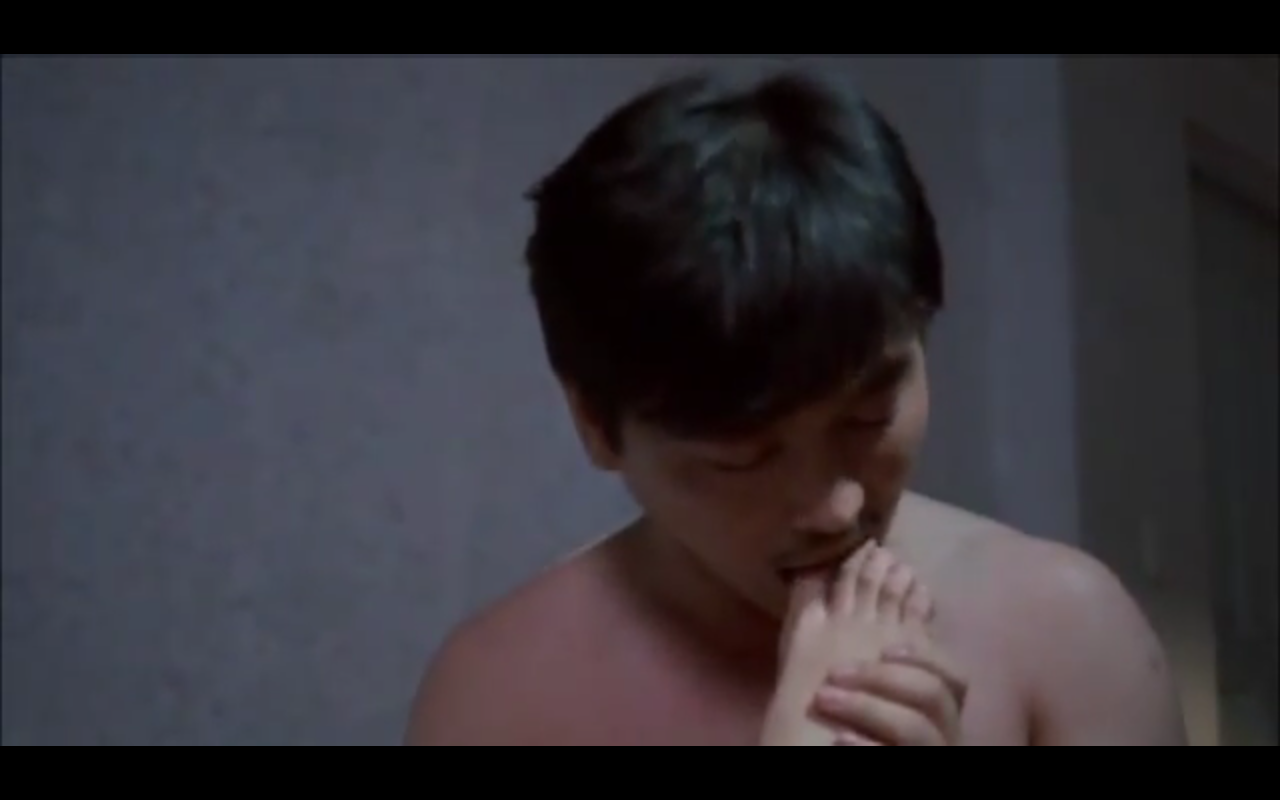
In a Sangsoo movie you're unsure what emotional expressions will produce. His sex scenes are rarely instigated by romance or love. Appropriately, his sex scenes tend to feel more like sexmaking than lovemaking.

He doesn't avoid sexiness that may be an aspect of the sex characters are having ('sexiness' is subjective of course, although his male gaze seems discernible, relatable).

(I attempt to keep my blog PG-13 to avoid that "I am an adult" check; though my photos are PG-13, I assure you Sangsoo does not shy away from sex.)
The movie's use of red lights seems atypical for him:
Seems like a device Sangsoo might now consider too pointed. In this movie, occasional harmony between visual and narrative meaning felt like instances of emphasis:

Part of me wants to say his movies have become more low-key in their depictions of beauty and mystery, but really I think beauty and mystery always make their way into Sangsoo's movies, but not in the same forms. Their appearances depend on the character, what they are doing, where they are, and what is happening to them. It's an obvious thing to say when talking about other moviemakers, but because Sangsoo's movies share a central philosophy, they can seem more similar than they really are.
As stated, Sangsoo's compositions aren't simple. They feel simple. His cinematic compositions, frozen and examined at one's leisure, reveal the imprint of themes and ideas and emotions and purpose.
When passing by you on the screen they can feel 'normal,' you might miss what's impressive about them.
He's an expert at drunk scenes. Who writes better drunk scenes? This movie has a great long sequence that involves a broken bottle used as a weapon and moments of true regret that result in the alienation of friends. Drunken behavior in his movies, as in real life, affords a moment of unveiling, an instance of something previously unrevealed finding expression.
Seems like Sangsoo doesn't go this 'big' anymore, but again, it could simply be a matter of opportunity. His characters' opportunities.
