
25 September 2012
18 September 2012
Taxi zum Klo
Labels:
80s,
Autobiographical,
Frank Ripploh,
Quote,
Sexy,
Taxi zum Klo
"You see, I like men. I'm thirty and a teacher by profession. Otherwise I'm your normal, jaded, neurotic, polymorphously perverse teacher. I radically separate my job from my private life and pleasures."

Frank Ripploh directs himself in Taxi zum Klo, a confessional autobiography.

It's like Half-Nelson if Half-Nelson was about sex not drugs, and if it'd been directed by the I Am Curious (Yellow) director.
 The density of Ripploh's admissions -- the extent of his insight into himself -- creates cohesive and lush textures and vibrant emotions and
 light, poetic details. It's like if Weekend had been made by the Little Fugitive people and this was one person.
This movie has most of my fav qualities, it's: earnest, candid, humorous, warm, curious, passionate, creative.
 Lots of sex. Gay sex. Ripploh is a gay swinger -- I care about judging this lifestyle about as much as he does. Which is not at all. There's a no-limits feeling, like Ripploh is willing to expose every part of himself. This Is How I Am Human, without barriers. In America right now we have people like Lena Dunham and Judd Apatow who make movies that are admissions of normalcy, and I think they do the same kind of thing, except they tend to take me places I've already been. Their narratives are kind of boring I think. Their lives are kind of boring I guess, it doesn't seem like they try to enlarge one's perspective of the world, it seems like they accept the world as it is and try to be mellow and not piss anyone off. I don't know, maybe they should try to shake things up a bit some time, maybe, I don't know. Just saying I'd rather hang out with Ripploh.
 Just saying.
 The fact that he's a teacher doesn't scare me. All people are horrible and some of them have to be teachers also -- I don't think Ripploh is particularly horrible and I don't think he "corrupts" the children. If my nieces had a teacher like Ripploh they'd be cooler, probably. They're pretty cool I'm just saying.
 Ripploh can kick it with people who don't share his lifestyle. He's comfortable being himself and lacks obvious insecurities about his character or his sexual orientation. That's cool.
 Ripploh reminds me of Portland. He reminds me of infinite possibility. He reminds me there's no mold -- and reminds me that those who ignore the molds are most interesting. He reminds me to be myself as much as fucking possible. He, I guess, helps me with my memory. His art is the type that connects with my sense of self and encourages me to expand and be fearless and honest and adventurous.
 Good movie :)


This movie has most of my fav qualities, it's: earnest, candid, humorous, warm, curious, passionate, creative.


27 August 2012
The Brown Bunny
Labels:
00s,
American Independent,
Art House,
Romance,
The Brown Bunny,
Vincent Gallo
"i've never been a popular person, but it doesn't matter. i have everything in my life that i want. i'm not a walking publicity stunt. i'm not an anarchist, or bitter. i'm not trying to be subversive. i just try to remain unguarded, unprotected by fear, and agents and publicists, and i feel comfortable that way." vincent gallo
 there's the story in the bell jar about the poet esther eats with at a fancy restaurant, where everyone but the poet is dressed a certain way, and the poet uses his hands to eat his salad, "one piece of lettuce at a time." and no one whispers or stares at him rudely. esther uses this story to communicate her belief that it's not one's knowledge of a table fork's intended use that's essential, but that the fork handler has confidence.
basically, i'm comparing vincent gallo with that poet in the restaurant. that's how i see him -- eating lettuce with his hands in a fancy restaurant.
a single restaurant couldn't be analogous to all of cinema, there'd have to be multiple restaurants, because it seems clear that not everyone wants the same cinematic food.

 two weeks ago or thereabouts, over a shared bottle of sake, i told my roommate a problem i had was i wanted to see a movie in the theater but there wasn't a movie in the theater i wanted to see. and again he became mad at me for not wanting to see the dark knight rises. it's his favorite routine. it's either the dark night rises or fincher's girl with the dragon tattoo or slumdog millionare or some other movie. i sense that he wants me to see these movies not because i might like them, but because he likes them so much.
amid my explanations for not wanting to see the dark knight rises, he accused me of not wanting to see the movie because it's popular. he was so off it startled me. we weren't having the same conversation. it took me a day and a half to figure out where the assumption came from. i realized there's this perception that the popularity of a movie has meaning -- that the numbers themselves have a meaning. this doesn't occur to me, not because i'm anti-numbers, but simply because numbers don't have the same meaning for me.
i like community, and i want it from cinema, but there are other things i want.
there are other things i want more.

 while having domestic squabbles with the local multiplex i can sometimes forget there are these really wonderful american movies, and i think that's because some of the most wonderful don't play in multiplexes. many american movies i think are really wonderful aren't popular, for one reason or another, and by popular i mean they don't get mentioned in glossy magazines or chatted about too much on television and people don't go to see them and things like that.
i don't at all think the pure fact of them being underseen or unappreciated makes them important or unimportant, culturally or otherwise. that's like thinking the person who's talking the loudest or whispering the quietest has the most valid opinion by virtue of their speaking volume.
this doesn't apply strictly to independents either. when five-year engagement and the avengers were in the theater at the same time i asked my friend, who's a big alison brie fan, if the friend had seen five-year engagement, in which the supporting actors alison brie and chris pratt outperform the movie's leads, in my opinion. my friend told me he hadn't seen five-year engagement, that he doesn't go to the theater often, and that he chose to see the avengers because it was the more "culturally important" movie. well, i remember alison brier's wedding speech in five-year engagement better than i remember anything from the avengers. i took more from five-year engagement than the avengers. facts. but i don't blame my friend, i think the summer's first blockbuster, by a talented moviemaker with an exciting and huge cast of people, has many reasons for being seen, and i think a lot of blockbusters offer tremendous riches. prometheus was a pot of gold. abe lincoln vamp hunter had a lengthy action sequence that took place within, and used as weapons, stampeding horses, in 3d. snow white and the huntsman doesn't just have a magical godlike white unicorn that reigns over a lushly fantastical forest specialworld, the movie also uses this unicorn creature for a major dramatic beat. you can't not make this stuff up. skipping the dark knight rises i take the risk of missing riches. but you can't see everything, right, so we each make these little judgments about how we're going to spend our time based on the information we have about the thing and about ourselves.
we follow what sings to us. the voice that sings to me is weird and not the same voice everyone else hears, and sometimes i hate it for that, tell you the truth. and then in stronger moments i know and believe that if others aren't hearing it, i have more personal responsibility about remembering its song.
 i'm arguing with imaginary people.
gallo, right, the brown bunny, right. right right right.
over backstreets, passing white-shingled two-stories in the middle of bug-splatters and gas stations and highways and days turned to nights, one senses a feeling chases bud, and one senses a feeling bud chases.

bud's misery takes the shape of its environment.
sometimes the movie doesn't feel miserable.
things other than misery take place.
i think the movie is actually a quiet war against misery.
 or at least an investigation into misery.
its despair has a confessional tone that lends it a sense of earnestness. bud, a victim of tragedy, victimizes others, creating new tragedies. he's stuck in the cycle of humanness that pains him. he buzzes with pure and innocent fear. one notices his downcast eyes. his short replies. (his conversational goal seems to be to speak as little as possible without appearing rude.)
and i feel for him. for 93 beautiful minutes.


basically, i'm comparing vincent gallo with that poet in the restaurant. that's how i see him -- eating lettuce with his hands in a fancy restaurant.
a single restaurant couldn't be analogous to all of cinema, there'd have to be multiple restaurants, because it seems clear that not everyone wants the same cinematic food.

it's difficult to imagine a theater full of random people all liking and feeling positive about the brown bunny, based on people i know and movies that are popular. but because it doesn't appeal to everyone doesn't mean it wasn't made for everyone. this is important. gallo made his movie in a very specific way, but by all accounts (and i feel when watching the movie that) his intention was to make the movie for everyone. brown bunny doesn't operate on and isn't enriched by exclusionary cultural references or extraneous background knowledge.
the brown bunny exists as an unmappable curiosity, fine-tuned liked a person. its weight comes not from cinema, but from cinematic realness.
 it wasn't a popular movie, with the audience or with critics. in the recent sight and sound poll, brown bunny received one vote: american moviemaker josh safdie (pleasure of being robbed), who also voted milestones, korine's julien donkey-boy, and a maurice pialat movie.
i feel deep and meaningful connections to the brown bunny, more than i do with the majority of movies i see (and i see so many movies) and i guess that means things that don't appeal to everyone have the same capacity for personal meaning as movies that appeal to a greater number of people.
the brown bunny exists as an unmappable curiosity, fine-tuned liked a person. its weight comes not from cinema, but from cinematic realness.

i feel deep and meaningful connections to the brown bunny, more than i do with the majority of movies i see (and i see so many movies) and i guess that means things that don't appeal to everyone have the same capacity for personal meaning as movies that appeal to a greater number of people.

amid my explanations for not wanting to see the dark knight rises, he accused me of not wanting to see the movie because it's popular. he was so off it startled me. we weren't having the same conversation. it took me a day and a half to figure out where the assumption came from. i realized there's this perception that the popularity of a movie has meaning -- that the numbers themselves have a meaning. this doesn't occur to me, not because i'm anti-numbers, but simply because numbers don't have the same meaning for me.
i like community, and i want it from cinema, but there are other things i want.
there are other things i want more.

based on my familiarity with the type of movie the dark knight rises is, and its maker, and based on its trailers, the movie isn't my bag. my specific bag. it's not the thing i die for. and i might like the movie, when and if i see it, i might be totally wrong. but nothing about it immediately sings to me, and don't we all follow the things that sing to us?
when a movie plays in the theater that sings to me, like solondz's dark horse, or hansen-løve's goodbye first love, the value isn't related to b.o. receipts or attendance. that stuff doesn't matter in an ultimate sense. and a lot of people talk about how it's the business end and a lot of people talk about how it does matter, but the truth comes to people when they sit alone in the theater and experience the movie.
only the movie matters.
when a movie plays in the theater that sings to me, like solondz's dark horse, or hansen-løve's goodbye first love, the value isn't related to b.o. receipts or attendance. that stuff doesn't matter in an ultimate sense. and a lot of people talk about how it's the business end and a lot of people talk about how it does matter, but the truth comes to people when they sit alone in the theater and experience the movie.
only the movie matters.

i don't at all think the pure fact of them being underseen or unappreciated makes them important or unimportant, culturally or otherwise. that's like thinking the person who's talking the loudest or whispering the quietest has the most valid opinion by virtue of their speaking volume.
this doesn't apply strictly to independents either. when five-year engagement and the avengers were in the theater at the same time i asked my friend, who's a big alison brie fan, if the friend had seen five-year engagement, in which the supporting actors alison brie and chris pratt outperform the movie's leads, in my opinion. my friend told me he hadn't seen five-year engagement, that he doesn't go to the theater often, and that he chose to see the avengers because it was the more "culturally important" movie. well, i remember alison brier's wedding speech in five-year engagement better than i remember anything from the avengers. i took more from five-year engagement than the avengers. facts. but i don't blame my friend, i think the summer's first blockbuster, by a talented moviemaker with an exciting and huge cast of people, has many reasons for being seen, and i think a lot of blockbusters offer tremendous riches. prometheus was a pot of gold. abe lincoln vamp hunter had a lengthy action sequence that took place within, and used as weapons, stampeding horses, in 3d. snow white and the huntsman doesn't just have a magical godlike white unicorn that reigns over a lushly fantastical forest specialworld, the movie also uses this unicorn creature for a major dramatic beat. you can't not make this stuff up. skipping the dark knight rises i take the risk of missing riches. but you can't see everything, right, so we each make these little judgments about how we're going to spend our time based on the information we have about the thing and about ourselves.
we follow what sings to us. the voice that sings to me is weird and not the same voice everyone else hears, and sometimes i hate it for that, tell you the truth. and then in stronger moments i know and believe that if others aren't hearing it, i have more personal responsibility about remembering its song.

gallo, right, the brown bunny, right. right right right.
gallo does despair, as he does all things, without the traditional accompaniment of self-pity and self-consciousness. he doesn't apologize for having emotions.
the twisted confidence of his misery makes it a mini-miracle. if you've ever been around a person or people and had a bad feeling, and apologized to the person or people for having that bad feeling, there's a strength to be acquired through gallo and his art.
 the brown bunny is about bud clay (vincent gallo) feeling miserable while driving across america to los angeles. and i think the movie, by its patience and focus, captures many shades of misery that are important.
the twisted confidence of his misery makes it a mini-miracle. if you've ever been around a person or people and had a bad feeling, and apologized to the person or people for having that bad feeling, there's a strength to be acquired through gallo and his art.

both this movie and buffalo 66 have a lead collapsing inward on a very specific feeling.
until the movie's end one might not identify the brown bunny's central feeling as a specific emotion, (a large number of people would describe the movie through their own emotion, boredom,) but the attentive viewer senses an emotion hovering outside frame.
and car trips in general and the specific shots of this trip engender complex feelings about traveling -- the literal experience of traveling, reasons for traveling, feelings stirred by traveling, memories of travel, etc.
and car trips in general and the specific shots of this trip engender complex feelings about traveling -- the literal experience of traveling, reasons for traveling, feelings stirred by traveling, memories of travel, etc.
over backstreets, passing white-shingled two-stories in the middle of bug-splatters and gas stations and highways and days turned to nights, one senses a feeling chases bud, and one senses a feeling bud chases.

the first spoken word, "hi," comes at 6:27. bud to the country girl.
whom he ditches, promoting a feeling other than misery, or at least a compound misery. something like anger, disapproval, objection.
bud's misery takes the shape of its environment.
sometimes the movie doesn't feel miserable.
things other than misery take place.
i think the movie is actually a quiet war against misery.

its despair has a confessional tone that lends it a sense of earnestness. bud, a victim of tragedy, victimizes others, creating new tragedies. he's stuck in the cycle of humanness that pains him. he buzzes with pure and innocent fear. one notices his downcast eyes. his short replies. (his conversational goal seems to be to speak as little as possible without appearing rude.)
the divergent emotional textures have roughly each the same value in an eventless and drifting narrative. gallo doesn't emphasize emotions, doesn't suggest one is more important or greater than the other. this indifference is the indifference of a reality beyond the camera.

the movie makes me feel tender. i want to take care of buddy. didn't i begin this piece by defending buddy, by rooting for him? the movie draws it out of me, triggers my instincts to protect the weak. and that's because buddy's imperfections are as clear as his humanness and his frailty.
and i feel for him. for 93 beautiful minutes.

04 August 2012
Sight and Sound ballot (imaginary)
"The Docks of New York" (1928, dir. Josef von Sternberg)
"Killer of Sheep" (1979, dir. Charles Burnett)
"Chungking Express" (1994, dir. Wong Kar-wai)
"Friday Night " (2002, dir. Claire Denis)
"Vivre sa vie" (1962, dir. Jean-Luc Godard)
"The Hole" (1998, dir. Tsai Ming-liang)
"Four Adventures of Reinette and Mirabelle" (1987, dir. Eric Rohmer)
"Detour" (1945, dir. Edgar G. Ulmer)
"Melvin and Howard" (1980, dir. Jonathan Demme)
"Shadows in Paradise" (1986, dir. Aki Kaurismäki)
21 July 2012
The Body as Soul: Bruno Dumont's Hadewijch
Labels:
10s,
Art House,
Bruno Dumont,
Hadewijch,
Nunsploitation
Where did she come from, Julie Sokolowski? She plays Céline vel Hadewijch, the movie's lead. I can see her soul through her eyes, her face is an emotion.

When her face is absent, I think of seeing it.

I can't think of her 'neutral' expression, she seems always in some thought or feeling,

drawing some thing out of herself for the moment,

or searching for a thing,

or hiding,

or absorbing;

her face can crush me, I become destroyed with it,

because Céline's emotions become mine,

and I want so badly for her to have the good ones only.

But, life as it is, one takes the good one can get.


It's a romance story where the girl is unable to be with her love. Her father is a Professional Christian (minister), and her parents think she's home waiting for exam results. The audience knows of the tension between Céline and her father not because the movie stresses it through repetition, but because the only time Céline says a critical thing about a person is when she talks about her father ("jerk"), to her friend Yassine (Yassine Salime), whom she meets in a Paris cafe. At a concert along a river,

Yassine makes a move on Céline, before he knows better.


He likes her as a friend, but doesn't understand her all the way.

His brother Nassir (Karl Sarafidis), a devout Muslim, gets her.


Nassir has ideas about where Céline can direct her love for Christ. Though they practice different religions, they relate on mutual grounds of psycho-passion for God.

The movie makes the case that belief is a shared characteristic which becomes categorized by the particulars of religion.

This is Bruno Dumont's fifth movie, from 2009. I hadn't seen a movie of his since his debut, 1997's The Life of Jesus, a good movie, but I was amazed by the growth Dumont has made. He's a moviemaker who continues the exploration of the human soul through the art of cinema, and his Hadewijch has the soul-puncturing efficacy of honest and brave movies.

And I'm not referring to Dumont's bravery in confronting controversially extreme emotions -- that controversy will fade, and what lasts of that particular brand of bravery -- I'm referring to his cinematic quest to expose the interior truth of Céline. It's brave of a moviemaker to care about his lead so much that I'm overwhelmed by a desire to talk about the lead, instead of the moviemaker, and I seem unable to separate the emotions of the lead from the emotions of the movie. Dumont has made himself as invisible as possible; all his cinematic techniques are intended to focus the emotions of Céline. His technique burrows inward.

And by witnessing a movie burrow into itself, I begin to burrow into myself. Hadewijch is a movie I've carried in my thoughts (there are a surprising number of emotions and moments to recall, though the narrative feels 'loose'), and in my thoughts the movie has continued to grow in meaning and emotion.
20 July 2012
Chilly Scenes of Winter
Labels:
70s,
Chilly Scenes of Winter,
Joan Micklin Silver,
Quote,
Romance,
Romantic
"Why would you choose someone who loves you too little over someone who loves you too much?"
CHILLY SCENES OF WINTER
a fizzling romance drama from 1979
directed by Joan Micklin Silver

Suspect I would've preferred the 1976 novel Chilly Scenes of Winter by Ann Beattie to this 1979 movie directed by Joan Micklin Silver. This story of a man who becomes frantically and neurotically obsessed with a woman suffers from a kind of gloomy, sticky intensity; the result of neurotic excretions and a tendency to emphasize, tonally and thematically, the neuroses. Realworld neurotics orbit their fears around dramatically rich specifics that appeal to creative types as enhanceable details.
The match-up is corny, tedious, obvious. The method is common to movie narratives because movies tend to limit their tonal palettes, while novels tend to have more textures and perspectives. Not all movies do this and not all novels do that, but in my opinion, the first step toward making a boring movie is limiting your tonal palette. I believe a movie narrative should be like knocked over beer dripping from the edge of a table. I can think of at least a handful of neurotic, obsessive, male-centered romance movies from the 70s and 80s, and they're all damaged by a sweaty-palm nervousness.
The match-up is corny, tedious, obvious. The method is common to movie narratives because movies tend to limit their tonal palettes, while novels tend to have more textures and perspectives. Not all movies do this and not all novels do that, but in my opinion, the first step toward making a boring movie is limiting your tonal palette. I believe a movie narrative should be like knocked over beer dripping from the edge of a table. I can think of at least a handful of neurotic, obsessive, male-centered romance movies from the 70s and 80s, and they're all damaged by a sweaty-palm nervousness.
So we're all on the same page, this is my personal definition of neurosis:
neurosis |n(y)oŏˈrōsis|
noun ( pl. -ses |-ˌsēz|)
mental incapacity to be mellow, for more than
like two seconds
Charles (John Heard) romances co-worker Laura (Mary Beth Hurt), his affection for her as immediate as his attraction. She's six weeks into a marriage separation
"If I make you feel terrific will you marry me?"
Charles swiftly angles for Laura to move in with him, which she does. He adores her. She's everything he wants. She's unsure. While living together, Charles begins to worry there's a problem with the relationship, and hounds Laura with needy insecure questions, and by worrying creates a problem.
The love Charles has isn't the same kind of love Laura seems to be looking for, or rather, Laura isn't sure what she's looking for and wants space to decide, but Charles crowds her because he's so sure.
The relationship lasted two months and occurred before the movie's narrative.
Laura returned to her husband.
The relationship is told through flashbacks, and the narrative takes place a year after the break up, when Charles begins to act on his longing for Laura.
He breaks a long radio silence, by calling Laura and asking to see her. Before the call, he promises himself not to beg.
She agrees to see him.
Seeing her makes him desperate to have her again.
The movie excels when it handles character emotions with tender earnestness. One can sense the flames of desire between Charles and Laura, and sense his fevered passion, and her earnest confusion. My fav thing about the narrative is how it renders a compassionate portrait of romantic despair.
The love Charles has isn't the same kind of love Laura seems to be looking for, or rather, Laura isn't sure what she's looking for and wants space to decide, but Charles crowds her because he's so sure.
The relationship lasted two months and occurred before the movie's narrative.
Laura returned to her husband.
The relationship is told through flashbacks, and the narrative takes place a year after the break up, when Charles begins to act on his longing for Laura.
He breaks a long radio silence, by calling Laura and asking to see her. Before the call, he promises himself not to beg.
She agrees to see him.
Seeing her makes him desperate to have her again.
The movie excels when it handles character emotions with tender earnestness. One can sense the flames of desire between Charles and Laura, and sense his fevered passion, and her earnest confusion. My fav thing about the narrative is how it renders a compassionate portrait of romantic despair.
The melodramatically suicidal mother of Charles is probs my fav character.
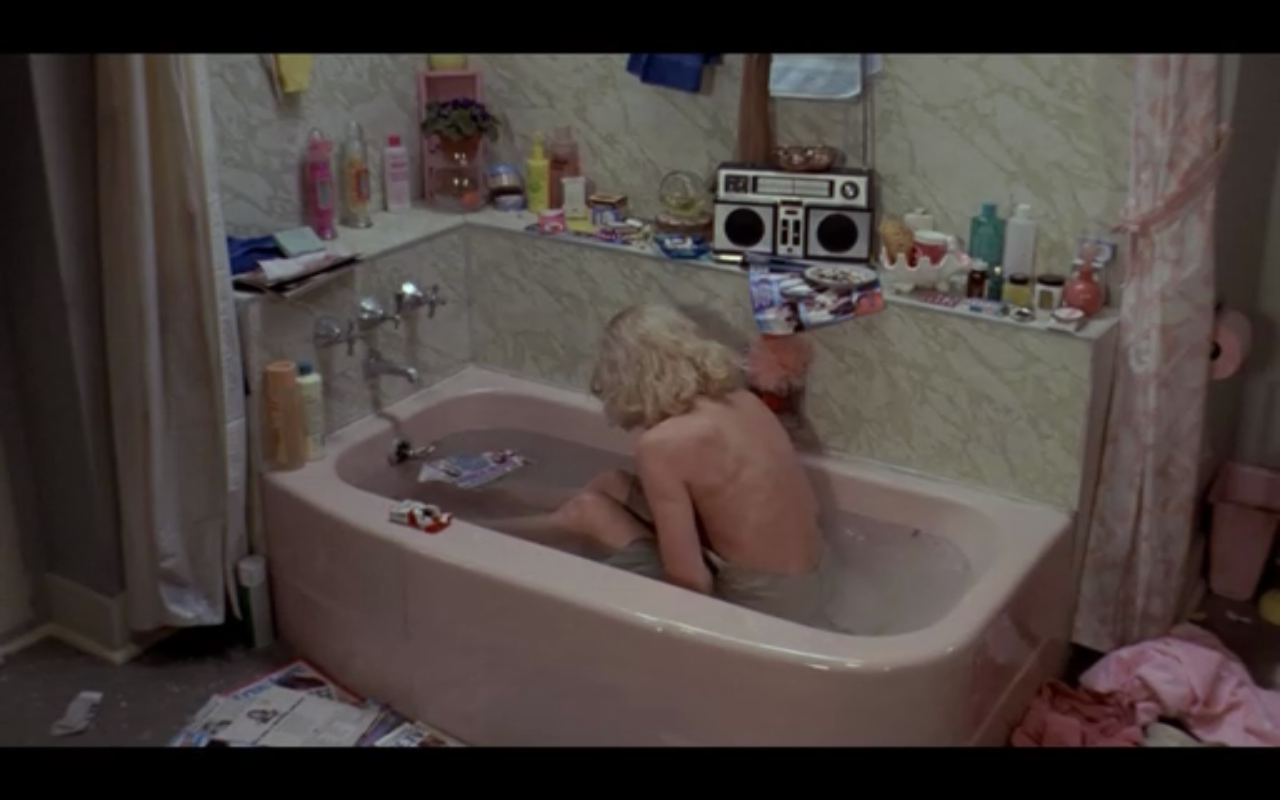
"I think one day she just decided to go nuts because it's easier that way. That way she can lie around in the bathtub, and say whatever she wants, and hit the scotch whenever she feels like it, and just not do anything. Sort of tempting, isn't it?"
I like the mother's excessive mania, which though it instigates drama, doesn't seem to seek or mean to create drama. Charles is an emotional tornado, his mother is the storm in the clouds.
I like the mother's excessive mania, which though it instigates drama, doesn't seem to seek or mean to create drama. Charles is an emotional tornado, his mother is the storm in the clouds.
"Susan. Susan always appears to be happy and normal. She must know something."
(this next section discusses the movie's ending)
(this next section discusses the movie's ending)
According to Matthew 1: 6-11,
"The movie was first released under the title Head Over Heels to avoid the dreary connotations of 'chilly' and 'winter.' Director Joan Micklin Silver, with the studio's encouragement, also opted for an upbeat, optimistic ending that was faithful in spirit to the fadeout of Beattie's novel. But none of this helped the film find an audience and the reviewers who compared it unfavorably to Annie Hall (1977), Woody Allen's equally quirky comedy-romance, didn't help either. So Head Over Heels was shelved until UA's Classic division came along and decided to give it another chance in 1982."
in '82 the movie was rereleased with the Chilly Scenes of Winter title, and according to Matthew 2:2
"The distributor also removed the original happy ending and substituted an alternate one which was more downbeat but true to the film's melancholy tone and wintry look."
The version I saw was the '82 version. I'd like to see the original.
19 July 2012
Subscribe to:
Posts (Atom)