Showing posts with label Trash. Show all posts

18 January 2012

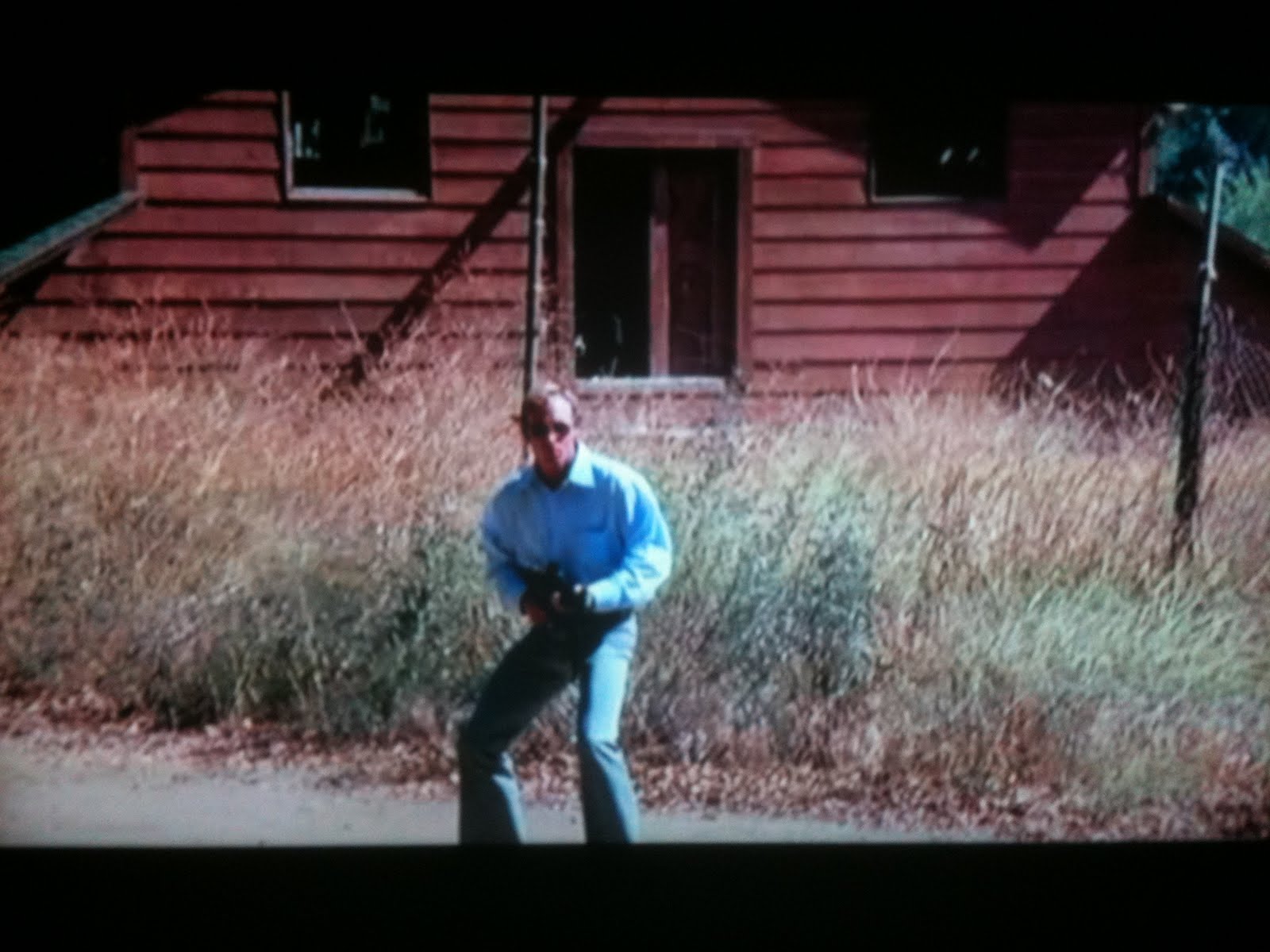
The Longshot (1986) and some Heartbeeps


Dooley: Five big ones. Uh, not big ones like five dollars, but, uh … how do you say five thousand?


Lizard: (Beat) Five thousand.
Dooley: Right, that's, five thousand. I didn't know the term.

Paul Bartel delights me to no end. 1986's The Longshot tells straight-facedly a ridiculous story about four ordinary guys who want to bet big on a horse race.


Lou: Dooley I've been thinking. You can pull this off for us. All you gotta do is to waltz over to Ms. Big Bucks and see if she'd be interested in giving us a little back up loan.
Dooley: What are you talking about?
Lou: Nicki Dixon, the broad at the track. You said she got the hots for ya.
Dooley: W-wait a minute. I'm not selling this body.
Elton: You mean that piece of shit is for sale?
Lou: Listen, you don't have to romance her. [Something]. Those rich broads love to tell the girls at the club how they lend ten grand to some putz for no reason at all. And then maybe with a little wine, a little song, maybe you'll get lucky.
Elton: He may be able to do a little singing and a little sippin of the wine, but when it comes to women his winky is retired.
Lou: Winky? A grown man calls the ol' joystick a winky?
Stump: Why can't you call your wizzer a winky if you want?
Lou: 'Cause it's stupid, that's why. Who besides him do you know that would call a dork a winky? Right?
Dooley: Yeah, call it what it is.
Lou: There, you see. What do you call it?
Dooley: A monkey.
Lou: You're gonna get us this loan with a jug of wine, a loaf of bred, and a monkey?

Bartel downplays the ridiculous and emphasizes the ordinary, which I think makes the ordinary seem ridiculous and the ridiculous seem ordinary.

Clerk: Who shall I say is calling please?


Dooley: Hrm. Ah, um. Just tell her that the cigarette man is here. Oh no no … on second thought, tell her it's the guy from the track, with mud on his pants and a wet cigarette. She'll know.


Clerk: Good evening Ms. Dixon. There's a gentleman here from the track, with pants, and a cigarette.
Dooley: Mud. Mud on the pants.
Clerk: Mud. Mud, on the pants. And some cigarettes for you.


Dooley: From her. The cigarettes are from her, it was wet from her and they --


Clerk: From. You. I believe.

Tim Conway, who also wrote the amusing and likable screenplay, plays Dooley. Conway is an Ohio native who entered the entertainment industry through television alongside Ernie Anderson. I imagine Bartel enjoyed making the film, not because of the material necessarily, i.e. I don't think Bartel would have written this script, but I imagine he had affection for people who would want to make this type of movie, and in this instance that happened to include him.

Bartel was too cool, too sincere, too smart and too funny to turn his nose up to material he was handling. And to do so would have been to act like the snobby high culture elite, whom Bartel was so great at subverting with tasteful tastelessness. Bartel's fervent curiosity about all things high and low culture suggests that the world is full of living people loving things, and sometimes people with different loves and perspectives collide for humorous consequence, but all perspectives and passions are basically equal. Bartel revels in the peculiarities of society, its customs and interests, and The Longshot is full of tiny hilarities that come from careful observation of clashing worlds.


It's interesting to think that if Bartel hadn't made this movie I probably wouldn't have watched it, and that there are movies like this that Bartel didn't make that I don't feel a desire to watch. If The Longshot hadn't been made by Bartel I don't think it would have been as joyful and loving. I think some comedy directors make it very clear what is a joke and what is not, and I think Bartel knows that everything is a joke.

In 1981, Michael Phillips, Allan Arkush, Andy Kaufman, Randy Quaid, Christopher Guest, John Williams, Stan Winston, and Tina Hirsch all came together to make a robot love story called Heartbeeps, obviously.

The sum of the names involved doesn't equal Heartbeeps, not for me. I think it's a kid's movie that works only for kids, maybe, if the movie does indeed work for kids. I was unable to forge an emotional connection with the movie. And I didn't find it entertaining. I found it boring, except the first ~10 minutes, which I thought were lovely and charming. I recommend the film up to the point in which the robots leave the factory, which I think happens after ~10 minutes, maybe before, but then the movie becomes a long game of hide-and-seek, and material about bears being called camels.

I bring it up because Mary Woronov and Paul Bartel make cameos!


Bartel's line, as a house guest, after the house has been destroyed, is "I don't know about some people, I thought it was a stunning affair."

EDIT FROM THE FUTURE: Last night (2/27) I realized that Robby Müller shot Bartel's The Longshot. Very cool.

06 November 2011

Tower Heist

I couldn't compile a substantial list of good reasons for seeing Tower Heist before I went to see Tower Heist. Most reviews and word of mouth were negative. The people who did say a couple positive things about the movie sounded like they were on party drugs, like they could only say it had been a 'good time' without clear evidence of why it was a good time. I went to see the movie anyway because I wanted to see the movie.

I laughed out loud approximately seven times during the movie. This is a high number for me, especially since I saw the movie stone sober at 12pm on a Saturday. There were two other people in the theater; for whatever reasons our laughter was never synchronized. Sometimes one other person repeated back lines at the screen, moments after the line had been spoken, a phenomenon I've encountered before which completely boggles me. I have done it (repeated a line), but I can't think of what the reason was, and whether or not I had a good one.

The first time I really laughed was when Special Agent Claire Denham (Téa Leoni) and Josh Kovacs (Ben Stiller) share some drinks and Claire drunkenly says she will take a 'crab' home. I laughed so hard. Leoni did a great job playing drunk. Why is she not used more? Has no one seen Flirting with Disaster? Téa Leoni is funny. The second time I laughed really hard had something to do with Mr. Fitzhugh (Matthew Broderick) I'm pretty sure. Can't remember what exactly*, but I enjoyed Broderick's nebbish, anxious Mr. Fitzhugh. Broderick is great at comedic subtlety, and this would be his best performance of the year, if his best performance of the year wasn't in Margaret. There was also a scene in which robbery intel was interrupted by a conversation about lesbians. I thought the scene was executed seamlessly and for hilarious effect. "A gauntlet of lesbians." Eddie Murphy is in the movie too. He is very funny.

The narrative is ridiculous and should not be taken seriously. Not all narratives need to be taken seriously, it's not a big deal. The only problem, as other reviewers have mentioned, is the third act heist is too long. I speculate the third act heist feels too long because the dramatic beats interfere with the character moments that are the best part of the movie.

Tower Heist has an ADD narrative and that's great. Some scenes were so short and ended so abruptly I almost felt like the joke had been omitted. *I just remembered the Mr. Fitzhugh joke - it's when they're putting the team together and Kovacs asks Mr. Fitzhugh if he's in and Mr. Fitzhugh says "come back to me." Kind of reminds me of an Of Gods and Men scene.

It's my belief that films should subvert narrative conventions whenever possible and move at whatever speed they deem necessary. The idea of slow films being superior to fast films is an idea, and I don't believe ideas are rules. People who try to make rules for art are bad critics, not artists, and also not good critics. The speed of a film should be dictated by the needs of the narrative and by the director's perceived effects of speed upon the audience in relation to the intended experience. I'm not saying Tower Heist is great because it moves quickly, and to tell you the truth I haven't heard anyone criticize the movie for moving quickly, I'm just soapboxing because my opinion is the movie moves quickly and not only is this fine but it's great. I almost cried during Tower Heist, twice.

No one is hated by cinephiles like Tower Heist's director Brett Ratner is hated by cinephiles. No one. Because he's so hated it makes me view him as an outsider in mainstream filmmaking. Here is a filmmaker who many people think shouldn't be making films. Supposedly he's an arrogant womanizing asshole who is talentless, dilettantish, and stupid. Ratner will always have the last laugh, however, because he doesn't take himself too seriously. This is the thing people don't get that gives him his bizarre power. So in my eyes he's a wickedly flawed, potentially misguided, contentiously effective filmmaker. To me that sounds like the Hollywood filmmaker archetype, and in my mind it's a suitable personality for a creator of comedies. I'm not saying he's the best Hollywood filmmaker, but I am saying that I don't regret seeing Tower Heist.

16 October 2011

Stewart Raffill and Standing Ovation

Last night I showed my nieces Standing Ovation, a musical comedy by Stewart Raffil. I had seen the movie 1 1/4 times previously. It was their first time. At first they weren't excited. Multiple times they asked me how I had heard about the movie. They seemed to find it interesting, perhaps even alarming, that a) this movie existed b) I knew this movie existed because I had seen it before.

Stewart Raffill's career strikes me as enviable. He specializes in films made for children. I speculate that making children's films for a lifetime could result in a lifetime of endless fun. Exhibit A: In 1974 Raffill made his feature debut The Tender Warrior. This is the synopsis for that film, taken from IMDb:
The sheriff of a small Georgia town on the edge of the Okefenokee Swamp does nothing to stop a family of white-trash moonshiners from trapping and killing defenseless animals. But Sammy, a young swamp-boy, takes matters into his own hands. Assisted by his pet chimp, Chuck, Sammy launches a campaign to free the trapped animals. "Pa" Lucas and his idiot sons don't take kindly to Sammy's scheme of beating them out of butter-and-egg money, and are soon chasing Sammy and Chuck over swamp and quagmire. As if young Sammy didn't have enough troubles eluding the Lucas family, he soon finds himself being hotly pursed by a leopard, an escapee from a circus.
As of today The Tender Warrior has an average IMDb rating of 4.5, which is a fairly typical average for Raffill, whose films have low averages on IMDb. His average rating on IMDb shouldn't be important to him, because he's making movies for fun, and having fun making movies, and making movies for kids. His highest average is 6.3, for 1974's When the North Wind Blows, his second film, the follow up to The Tender Warrior (NB: I'd like to encourage my friends to nickname me The Tender Warrior). His lowest average is 2.9, for 2010's Standing Ovation, his eighteenth feature film, and the film that started me talking about Raffill today.

Raffill isn't only the director of these wonderful (?) children's movies, he's also wrote many of them. I wouldn't have guessed, judging by Standing Ovation alone, that Raffill was the writer of at least sixteen prior features. But I'm happy to learn. Tammy and the T-Rex is my favorite title within his filmmography. Mac and Me is his film that I've heard of the most, though I often encounter, and considering purchasing, the The Ice Pirates dvd. I'm 75% sure that I saw his movie Mannequin: On the Move on cable when I was a child; my memories of this movie are fond. By far my favorite poster for one of his movies is:


I would hang the High Risk poster over a desk I planned to work from, and every day it would bring me inspiration and motivate me to travel further into my imagination.

My nieces were reluctant to watch Standing Ovation because the Netflix average user rating was 3 stars. I told them my star rating would be higher and not to worry. Briefly they considered watching Tangled for an eighth time, but either I convinced them to try something new, or Olivia did not want to watch Tangled for an eight time even if Claire did so there was going to be no watching Tangled and why not watch what Uncle Shawn wants us to watch.

Immediately they commented, to my genuine surprise, that some of the acting in Standing Ovation is bad. They made this observation within the first couple minutes of the movie, and repeated it throughout the movie at irregular intervals. Sometimes they recoiled in their seats and commented on how a thing happening in the movie was bad or awful or ridiculous or was I serious. My surprise was due to the fact that I had watched some Disney Channel shows with them, and had considered the acting in those shows bad, but had never heard them say so, although during Standing Ovation they said so many times. This is probably because the "bad acting" in Standing Ovation is actually a complex mixture of bad acting, bad writing, bad staging, and bad directing. My nieces knew when something was wrong, but, owing to the recentness of their sense of critical awareness, were not always able to pinpoint exactly what was wrong.

Early into the movie I had to pick up a third niece from her high school homecoming dance. The trip took about ten minutes. When I returned it was the scene in the movie when The Five Ovations are eating at the same place as The Wiggies. I could tell my nieces were now hooked because when I entered the room Claire told me "I love Joei!" The song in this scene, Soup to Nuts, went over really well, and the nieces kept repeating "Sit up straight, or you get no food," even after the scene was over. We were perhaps howling with laughter and slapping our knees or something, can't remember, but it was definitely good times at this point.

We all four of us let go and began to really (?) enjoy the movie. Letting go is something you have to do when watching a movie like this, and when you do a kind of magical thing happens. Not sure I can describe it - something to do with how "good" or "serious" movies require you to be "good" or "serious" during them, while during a movie like Standing Ovation you can be yourself. I think something about the film's flaws ultimately makes the movie easier to watch, which perhaps sounds ironic, but isn't. Think about how perfect seeming people are sometimes harder to talk to than people you can easily relate to and feel you share a handful of traits with.

Joei was a huge hit, as was her purse of bottomless surprises, of course. She was probably their favorite character, followed by Alanna Wannabe. Strong characters and personalities can be really important, whether it's a good movie or bad movie. Joei and Alanna are terrific characters because they're so expressive and funny and interesting. They're two smart roles to write for kids because kids want to be larger than life and centers of attention. If there's a character you can connect with and enjoy seeing, however ridiculous the movie, you are more likely to want to keep watching the movie.

I hyped up the final musical number, Shooting Star; like I told them "this is my favorite dance scene in the movie" before it began. It has a great opening that they appreciated, "I am D2, intergalactic space traveler with a female interface. Make. Me. Dance." And then Alanna is like "woo-ooo-ooo" in a high-pitched dreamy voice. Strong opening. When the energy began to dip Claire asked me something like "so what's the big deal" and I said "here he comes" because I had seen the movie and it was true that right then the little boy came out and said "I am D3, intergalactic space traveler with a male interface. Make. Me. Dance." and then he does all those dance-jumps and they my nieces were like quiet and totally into what was happening.

That night when they, my nieces, were going to bed, I told them that I hoped they danced in their dreams. I'm pretty sure they knew what I meant, because we had just watched Standing Ovation.

26 August 2011

Teen Wolf ('85) and some Standing Ovation

Teen Wolf begins with a great sequence: Scott Howard (Michael J. Fox) approaches the free throw line. His team, the Beavers, are being crushed by rival team the Dragons. I can't remember if he makes his shot, probably not, but what I remember is the sweat on his face and the intensity of the moment. Heart beats may have been emphasized on the soundtrack as well, but if not then, definitely later in the film. Coach Bobby Finstock (Jay Tarses) wants to forfeit the game, but the Dragons' coach doesn't allow it, since this game will increase his players' league stats. The Beavers get womped! Seriously, they lose so bad, and Scott even misses his buzzer-beating final shot.

This is a movie that gets going right away: during the first sequence you know Scott will become a werewolf. Because the titles begin the movie, but also because he growls at archenemy Mick McAllister (Mark Arnold). You're like, whoa. It surprised me to learn that director Rod Daniel came from television! Teen Wolf's cinematic touches made this film way more enjoyable than, say, Buffy the Vampire Slayer, and Rod Daniel knew how to have fun. Stephanie and I were cracking up during his movie, and I think maybe high-fived a couple times, and once, I swear, she said, while watching Teen Wolf, "This is why I love movies," or something like that, maybe "The only movie I'll ever love from here on is Teen Wolf. Oh Teen Wolf, you have won my heart and it is yours forever." I can't remember the exact phrasing.

When Scott's eyes turn red and he speaks in his wolf voice to demand a keg of beer, the movie entered my heart. It's such a silly, perfect scene. I believe the keg scene is directly followed by Rupert 'Stiles' Stilinski (Jerry Levine) surfing on top of the moving van. At that point I was really getting excited and was having thoughts like "Don't make 'em like this anymore," which is a thought that made me think I need more movies like Teen Wolf in my life - maybe they still make them like this, where are they, please let me know.

I watched Standing Ovation recently, and that was a lot of fun. I don't think it's the same thing, however, because when I recommended it to a friend he texted me, "And why am I watching standing ovation? Im 7 minutes into it and am more confused than ever why you thought of me. Im gonna try to sit with it." I'll have to recommend Teen Wolf; I really don't think this person could say the same thing about Teen Wolf. But maybe, there's just no accounting for taste.

One thing I was confused about was Teen Wolf's message. In the movie Scott decides to be his human self and not showboat his werewolf side, so I guess the movie is saying he should like himself for who he is and not for who people want him to be, but he is actually a werewolf. In the movie he's actually a werewolf. So why shouldn't he be a werewolf all the time? Doesn't that mean the message is really that we should accept mediocrity and never reach for higher aspirations because doing so may affect the status quo and possibly shatter our complacency? There's also something about how becoming a werewolf gives Scott confidence but he learns by the end of the movie that he doesn't need to transmogrify in order to have confidence. And he ends up with his friend Lisa 'Boof' Marconi (Susan Ursitti), the girl who liked him all along and liked him for him, not for werewolf-him. That still seems like the message is things are fine the way they are and we don't need to ask for more or want alterations in a life that's livable as it is.

That's stupid. Personally, this movie made me want to be a werewolf. I think that's a perfectly fine message to send to kids, and I don't understand why the movie wanted to complicate things in the end. Other evidence of normalcy brainwashing: when Stiles (pretty much the coolest guy in the movie because people seem to really like having him around and he brings genuine joy with him, and he wears sunglasses in a lot of scenes) gets back a D- test grade and he shows it to someone with a bit of pride, presumably because it's not an F. I guess the movie had to cut into him like that and imply that he's a person of limited intellectual depth, because it supports the subplot about his opportunism, but also because it reinforces the central motif about normalcy being the best option. It's like, he can't wear the brightest and best shirts and be a smart guy, no way, this movie wouldn't allow it. This sensibility flatters the Normal Kid who sees Teen Wolf in the mall or wherever, and Normal Kid leaves the theater thinking he's perfectly cool the way he is. Teen Wolf is like, yep, just be Normal Kid, you're fine, get out of here (buy some soda on the way out). I just think the better message is about not being afraid of change and exploration of your internal and external possibilities.

Sure they win their final basketball game due to inner powers, but that's not realistic, that doesn't usually happen, and if it does it's an unusual circumstance and becomes some Yahoo News headline. They didn't even have to work to become better at basketball. There were no practice montages, and I don't think Chubby (Mark Holton) ever went on his diet, not really. That tells kids miracles occur, it goes full-throttle on a stupid movie miracle, so why not on a great movie miracle like lycanthropy. Have werewolf Scott eat a kid's head, who gives a fuck?

Of course, you can forgive the film for this conservatism because of its great scenes, like the wolf dance during prom.

You can also forgive the film for having actors in their mid-20s play high schoolers, no suspension of disbelief required: they're all in their 20s; they've stuck to high school because they don't believe there's reason to move on or go forward, life has nothing special to offer them. Their lives are frozen. Then, Scott turns into a werewolf, and they all begin to believe, and you know they're on the cusp of graduation into adulthood and an acceptance of unlimited possibilities. See, that makes the movie even more magical. And if you want to see Michael J. Fox nearer the correct age and in high school, there's always Class of 1984.

09 July 2011

Vigilante Force (!)


Vigilante Force begins with some manic fucking hellraising. Within the one minute mark, while the credits are still rolling: guns are fired from the bed of a moving truck, a man is dragged down the length of a bar by another man in a cowboy hat, a high-heeled woman in a bikini dances on a pool table for cash money, a roulette wheel is spun, there is a bar fight which escalates to gun violence - and then all out pandemonium (guys being thrown onto tables and stuff), and for what appears to be completely unrelated reasons (unrelated to the bar fight) a man is thrown out a window in a coffee shop, followed by a police car being set on a fire (with a fucking torch) and shot at until it explodes.

This is followed by an early morning robbery getaway sequence. Three men with guns, and either a woman accomplice, or a female hostage, flee to their car while exchanging bullets with the police. Two officers, and an elderly bystander, are shot.

The town is overrun by criminal behavior.

Residents don't feel safe walking down front street anymore. Harry, the sheriff, can't be everywhere at once. He's losing men. Ben Arnold (Jan-Michael Vincent), a young tractor salesman and local, has a Vietnam vet brother, a "genuine war hero," whom he offers to contact for auxiliary police protection.

Aaron Arnold (Kris Kristofferson) agrees to the arrangement on the condition that he can bring with him four friends, friends he promises are war vets and/or ex-police. They're sworn in and issued guns, badges, and handcuffs.

Vigilante Force was written and directed by George Armitage (Miami Blues), with production design by Jack Fisk. It was produced by Gene Corman and released by United Artists in 1976. Kris Kristofferson plays a softer, but not much softer, Kurt Russell type. He controls the criminal population in order to cheat the town himself, and the movie is about his betrayal of the trust offered to him.

This means a cycle of corruption, violent action, and town drama. It's my opinion that no one in the movie is interesting except Kristofferson as Aaron. But he's pretty interesting. The film first made me lose my shit when Aaron breaks up a cockfight by pistol shooting the roosters dead in front of the crowd of betters. "You're all under arrest" is his line.

The problem is Armitage doesn't make me care about anyone, so who gives a fuck about his outrageous, ridiculous southern anarchy narrative. It's tedious and drags itself through a slow middle half that's only punctured by Aaron shooting two roosters. Except, at the end, the movie take off. TAKES OFF. It's the end of the movie I want to describe, and part of the ending's charm when watching the film is its surprising pay offs, emphasis on surprise, and I don't recommend you read the next section or look at its pictures unless you've seen the movie. BUT I also recommend you do check out the next section, even if you haven't seen the movie, if your position is still that you don't think you should watch this movie, because you totally should.

THE END OF THE MOVIE


Evil Aaron and his evil friends disguise themselves as a marching band and intend to use their small arsenal to rob something I forget what.


Ben has assembled a vigilante group (earlier, around a pick-up truck, he'd been like, "I'm the one that brought you here, and I'm the one that's gonna run you out," to a topless Aaron, who'd been saying stuff like "Now you listen to me I didn't volunteer for this").


Ben tries yelling down some threats. There's a stand off. It's intense. Aaron tests Ben's seriousness.


Ben is very serious.


Hell breaks loose. It's insane. They just don't make pandemonium like they make pandemonium in the US south. Guns are fired, things explode, people are given hell, people take cover.


In one instance ...


a woman with a Molotov cocktail ...


throws the Molotov cocktail ...


at a man ...


whom she hits ...


who presumably dies a horrible, painful, fiery death.


The action heads to the nearby ghost town, where things are settled the only way these things can be settled.

09 March 2011

District B13, District 13: Ultimatum, and Taken

Sometimes, while watching Pierre Morel's Taken, I felt a sense of magic. Not about the movie, but about me. I felt like a soothsayer, because I knew what was going to happen next and what was going to be said next (most people will), especially in those beginning thirty minutes, before the daughter is kidnapped, when the characters and their relationships are being set up. I'm not just being an asshole, I'm also being sincere: there was truly an instance in which I mouthed the dialogue along with the actress (Famke Janssen), despite never having seen the film or read the script.

It's clear that Besson now concocts whole films around a handful of attractive and sensational elements, and then hires a screenwriter to attach bullshit and perfunctory story formulas. That's too bad, on the one hand, because I'm speaking about the same Besson who once gave us better films like Le Dernier Combat (which had the courage to be what these films should be - without dialogue; some action movies in the future, I hope, will be more like silent films), The Big Blue, La Femme Nikita ... well you know who Besson is. In District 13: Ultimatum's blu-ray special features there's an interview with Cyril Raffaelli, who had a starring role in both District B13 movies and also served as fight choreographer. In this interview he's describing a moment in which he discussed his idea for a fight scene with Besson, who seemed pleased with what he was hearing. "Just so you know," Besson told him, "in this scene you're going to be holding a Van Gogh."

It's pretty great, on the other hand, because Besson still wants to create cinematic special-worlds, engineered for the delight of an appreciative audience. The action moments of Taken are when Morel shines the most, naturally, and I don't mind the way he emphasizes cinematic propulsion over continuity and logic. He edits purely for the sensational delight of the audience, and a late car chase and fight scene were expressionistic and thrilling rather than realistic and detailed. I don't mind that at all. He succeeds in engaging the audience because he thinks as an audience member seeking escapism, exaggerated emotions ("I don't like realistic movies," a friend once told me, "no, real life is boring enough.") and heightened experiences.

But in my opinion if you're going to exaggerate, and I've said this before, exaggerate all the fucking way. District B13, for example, is indeed a better movie than Taken. Not because it's smarter, no no no, but because it succeeds in capturing the bliss of decadent fantasy. It's as if the French found an abandoned Escape from New York narrative vehicle, hot-wired the thing, and drove it into 21st century Paris. Glorious! The extent of the liberation you allow your imagination is the difference between a low or high-brow film and a middle-brow film, and middle-brow films are worthless in every way except generating ticket sales and quickly becoming forgotten.

This is also why I think District 13: Ultimatum is better than District B13, even though I fell asleep three times while watching it(?!). District B13 used actor Bibi Naceri (who plays the crime lord in the movie) as co-screenwriter, and he and Besson designed some story about, um, revenge and valor, things like that. No co-screenwriter is listed for Ultimatum, and themes are borrowed from the original. Based on the Raffaelli story about the Van Gogh, and the experience of having watched the movie, I'd speculate they made the shit up while they went along, i.e. action took precedence over story. That's how they sometimes work in Hong Kong too, and I've come to appreciate the method. It allows for the superficial elements of the movie to shine, as it should.

General opinion seems to be that District B13 is the better movie. That's probably because its narrative makes more sense, relatively, and so its action has more meaning or impact. Get out of town. The meaning of the District B13 movies is action, and its true themes are punches, kicks, and parkour. Ultimatum clearly better develops these themes. The story, as it is, is ten times more confounding, outrageous, and unbelievable; as it should be. If I'm going to have a conversation with a crazy person, I want to have a conversation with the craziest goddamn person in the city, personally.

09 January 2011

Mystics in Bali!

Old Leák Queen: What is her name, and where does she come from?
Catherine: Catherine Kean from the USA.
Old Leák Queen: Hmm. And where is that?
Mahendra: Very far away.
"Here there is even a western actress playing a key role. In fact, the elusive Ilona Agathe Bastian was not an actress at all, but a German tourist holidaying in Bali. She was spotted by the wife of one of the film's producers and it didn't take much to persuade her to stay on for a few months free holiday." -production notes.

H. Tjut Djalil is a new hero of mine. This, Mystics in Bali, is the second film of his I've seen, following Lady Terminator. He is a director of keen imagination and sharp cinematic wit. Roughly a year ago I didn't even know Eastern black magic horror films existed. Which is appropriate: here I was in the house of film, and black magic was being practiced in the back yard. Of course! The ones that I've seen, including a recent theatrical screening of Boxer's Omen, are among the craziest, most enjoyable movies I've ever seen. They lack the tiresome earnestness and rectitude of Christian horror films, and their potential for engaging supernatural phenomenon is greater.

"I'm surprised that a pretty girl like you would be interested in learning black magic."
- the first line of Mystics in Bali

H. Tjut Djalil is a genre surrealist. Neutral, monotonic voice dubs and plastic-faced actors engender a strange impassiveness as the protagonists journey to learn the intricacies of Leak Bali, a black magic which could be the church of Lynch. The roots of its power seem to be joyless high-pitched laughter. The laughter is one aspect of black magic taught by the face-shifting Old Leák Queen, who takes on Catherine as an apprentice. Of the things the Old Leák Queen teaches Catherine, the most important is drinking newborn blood by way of disembodied, floating head.


Blood has a restorative power for the Leaks, and infant blood is best. Like other exploitation movies, kicks are to be had, intentional and not. Some of the dialogue exits in this movie are extraordinary. When Catherine vomits green goo and live mice, Mahendra blames the prior evening's meal! Absurd on the one hand, but true on the other: does Mahendra know of the prior evening's metamorphosis, the transformation of Catherine from human to pig (Leaks can do this[!])?

Mahendra starts Catherine down the dark path of black magic. She asks him to; she's learned about African Voodooism already, and now wants introduction to Leak Bali, the strongest black magic in the world. It ends badly, unfortunately for Catherine and Mahendra, but fortunately for the audience, and really Mahendra is a great guy who cared about Catherine and meant best.

08 January 2011

Buffy the Vampire Slayer (1992)

If I'm going to dig through the trash, I'm bound to inspect other people's garbage. Buffy the Vampire Slayer, the 1992 movie, puts to the test my idea of a lasting place for all films in curious hearts, and a permanent value for them as historical records. A recent theatrical opportunity was, like Basket Case, a testament to the fervor of its followers, who might say the film isn't material for a tolerance test but good material. Simply, I disagree with the assertion in Buffy's case, and remain interminably ignorant of the television show and the show's spin-off. I consider it passable material.

I'll attempt to avoid dismissive language that might reduce the conversation to the purely taste based. As a film, Buffy is a specific breed of popular 90s filmmaking: a vampire element (genre emblem) is subordinate to related vampire hunting mythology (subgenre), subordinate to teenage allegory (demographic), subordinate to broad ranged teen comedy (Hollywood). It's execution is as a generic and broad ranged teen comedy. It functions as a teenage allegory as the vampire myth is secondary to the myth of Buffy, and the film is structured on her acceptance of new adult roles. Its efficacy boils down to your emotional investment in Buffy, who is written to attract sympathy and become liked.

Mostly the direction is functional, sometimes perfunctory. Working directors, without personal agenda (or vision), from Sam Wood and Lloyd Bacon to the present, are always the first to be accused of artlessness. When you feel the hand of Fran Rubel Kuzui in the movie it's in short, disconnected moments; stylistic choices, like the perfect push in on Buffy when the vampires arrive at the dance, are rare. It's occasionally decently written, sometimes entertaining. It can be both ("I'm the chosen one, and I choose to be shopping"). Too much time is spent satirizing 90's breed airheads, and either airheads are now more sophisticated or, more likely, filmmakers have become more sophisticated at portraying them. Several actors in the film were popular at the time, and several made names for themselves later on. I don't think it's worth discussing in this case. The performances are neither good nor bad. They are conspicuously performances, people pretending, without passion. Several times humor is used to puncture the artificiality, most notably in the instance of Paul Reubens's prolonged death.

The movie's deficiency, compared to other movies of the type that I enjoy, is the limited scope of personal, internal material. Little is undiscoverable, mysterious, or captivating in either the written characters, the actors' performances, or anyone else involved, behind the camera or in front, and it fails to capture the reality of the time and place. It's clearly made in the 90s, but says nothing interesting about the 90s. The weak direction limits its potential as spectacular dross, and too the film's conventional middle-class values make it less thrilling, less compelling. Taken as a teen comedy, the vampire stuff gets in the way; a discordance that generates copious exposition potential for the writer, but ultimately reveals little about teenagers or vampires. As a character based drama it's most successful, but I have difficulties imagining an enduring legacy for Buffy without the television show.

02 January 2011

Lady Terminator!

"The role of Nyai Loro Kidul as a Javanese Spirit-Queen became a popular motif in traditional Javanese folklore and palace mythologies, as well as being tied in with the beauty of Sundanese and Javanese princesses. Another aspect of her mythology was her ability to change shape several times a day."

Lady Terminator is an Indonesian action myth-fi, based loosely on stories of the South Sea Queen, reinterpreted with central images borrowed from James Cameron's Terminator. It shares the action spectacle excess of outrageous Hollywood action films and the sloppy short-hand dramatics of a poorly written b-film. It was my first Indonesian genre film. My understanding is that there was a wave of these types of productions in Indonesia, and seeing this movie and later learning this feels like discovering treasure chests on the seabed of cinema.

The riches of this film are found in the execution of the material, its performance as a film narrative. It's written for an audience, by a filmmaker who thinks as an audience member, particularly an audience member seeing the movie in a mall or multiplex, the populist, consumerist audience member. It's written and directed to be this kind of mainstream formulaic movie, but the filmmaker fucks it up in a thousand exciting and different ways that make the film a thousand times more interesting than those movies usually are. For me the idea of a Hollywood style film from a non-Hollywood location is richly compelling, as with genre films from the southern United States, Australia, Hong Kong, South Korea, Japan, France, etc., because parts of the filmmaker's outsider personality will inherently corrode the mechanization of material that's such an annoying and artless feature of many Hollywood films themselves. The filmmakers who attempt to curb this natural tendency are the bad ones, the ones as bad as the Hollywood filmmakers. The filmmakers who make movies like Lady Terminator are gems, treasures of the film world, unconscious documentarians of the human soul in flight from reality.

The movie wisely steals several attractive features from the Terminator series: the tech noir vibe, the unstoppable murdering machine (with compelling backstory), and key scenes, including the downtown car chase (!), are directly imitated.


Most of the heavy-duty action material is performed by an actress named Barbara Anne Constable, who apparently acted in several other regional films and never expected Lady Terminator to be seen overseas. Lady Terminator is her sole credit listed on IMDb.

Constable is badass in Lady Terminator, in presence and performance. She does things no other human being will likely ever do, with a gusto and brazenness that only a skilled and daring actress could bring to a role. It's impossible to imagine her character existing in the real world, and yet simultaneously easy to sense the presence of a personality and distinct acting choices beneath her performance - qualities that bring the unreal to life! Her character is a spirit-possessed human, and this allows acting space for a role previously played, in the Terminator series, as emotionally barren by consequence of robotics.

Like many other action b-films the dialogue is dramatically perfunctory and bridges together action scenes. Unlike many other action b-films the action is frequent and engaging. Its successes are easy to calculate: play the film before an audience and listen to them. I saw it at the end of a triple-feature that began with Master of the Flying Guillotine and Gates of Hell aka City of the Living Dead and this one was my favorite - and I really like the first two - because most of the components that contribute to the perception of this film as a failure are for me very entertaining, interesting, and human, and all the little blemishes are simply stimulators for my imagination and curiosity, as with the best of films.

01 October 2010

Max Headroom, Episodes 1-4.

Television audiences today respect the outlining tenets proposed by a show's pilot, I think, I think they accept the interior logic of a show if that logic is conveyed persuasively and followed loyally. A show like Max Headroom could be done really well today. As it is, this episodic show - in its first four episodes, the ones I viewed - consistently commits self-betrayal and violates narrative and real world logic for the sake of cheap entertainment.

It's unfortunate, because the underlying concepts of the show are impressive. "Twenty minutes into the future" major network television stations compete for massive audiences (200 million at a time - assumably the world's population has continued on a precipitous path) and dire financial stakes. The leading network, Channel 23 XXIII, has an ace reporter named Edison who frequently risks personal and professional injury in order to expose corruption, scandal, exploitation, and the like. His show is very popular. It must be a cornerstone of the network because in the very first episode his critical eye turns on his own network: the episode is about him uncovering the tragic, body-exploding consequences of Channel 23's revenue generating blipverts (adverts shown in rapid montage, too quickly for anyone to turn the channel!). People explode because their nervous systems are underused and the accumulating energy from this stagnation is ignited by the mentally intense blipverts.

Max Headroom does an okay job of explaining the bullshit it makes up. A friend of mine recommended this show told me. He described it as prophetic, the way it depicts the pervasiveness of technology in everyday lives, but its representation is far removed from our present reality, and my friend should have told me that the show was prophetic about the way writers would use absurd technological imaginings in order to explain away plotholes in adventurous storylines. Anyway I watched the show because he used the word cyberpunk in his introduction, and there certainly is plenty of cyberpunk weirdness. According to Max Headroom, in the future people will be confused by places called Body Banks - they'll be clueless as to what goes on inside of them. There will be a thriving black market of human organ selling, safely concealed behind the impenetrable veil of the name Body Bank - what goes on in a Body Bank, who knows, the name is so misleading, life is complicated, there are so many people and such violence, no one can stop to figure out these Body Banks. Also, even though Edison's show is massively popular, he has no imitators. Everyone else is complacent, so it really is up to him.

I'm writing myself out of the idea that this show has a strong foundation. There are lots of glaring annoyances like I'm describing. In Episode 2 the youth strap engines onto their skateboards in order to move at the same speed they already do; there is apparently no advantage because the skaters continue to perform inside half-pipes. The magic of the show is that it even attempts to invent these things. Engines on skateboards - that's interesting, isn't it? I've never seen it before, but here it is in Max Headroom.

That's what I mean though, in the television days of Max Headroom you didn't have to think about these things, there was an uncanny suspension of disbelief. Or maybe not - the show only went fourteen or so episodes. Why underestimate the people of the past, why assume they bought this hook, line, and sinker? I doubt anyone thought Get Smart was an intelligent and penetrating expose into the world of spies. Yes, I'm missing the point, and the point is entertainment.

The lack of fixed rules and a sense of reality inhibits my ability to enjoy the show. Television, like film, is fundamentally manipulative, and almost always a lie, but when you misshape your show's design for the sake of a single episode, you betray your own set of lies, and destroy some of the bridges you've formed with your audience. Sometimes rules are betrayed for subversive means, but in Max Headroom it's always for dramatic purposes, and that cheapens the entertainment because it's hard for me to value what they themselves don't. For example, this spontaneous rule making applies also to Channel 23. It's headache inducing to examine how this station is supposedly run - the autonomous Max Headroom, whom I haven't even yet explained, and won't, supposedly goes live on the air at any moment, interrupting whatever else was on. According to this show, in the future there won't be television programming or scheduling, just whims and chaos.

In each episode Edison is put in a perilous situation, but in each episode he escapes. There's not much weight to his danger, then, and there certainly isn't an escalating sense of danger over a course of several episodes. Each episode has its little threats and its unique reasons with little communication between the episodes. These qualities do help keep the show fun. The dialogue is sometimes very snappy, and the camera is extraordinarily mobile for a television show. The characters are sharply defined, and the social backdrop is vibrant and compelling. Some of its central questions are meaningful, and its objectives are worthwhile. If only the created world of Max Headroom had been cherished. A great movie, with a little love and attention, could be made from the first episode alone.

11 March 2010

Friday the 13th: The Series, Episode 3.3, "Crippled Inside"


Image borrowed from Vendredi Antiques, a website devoted to cataloging and discussing the episodes of Friday the 13th: The Series, a show I had little knowledge of until last night, but now today could totally understand why there is this website and probably other websites constructed as memorials. Again, the image is:


I don't know enough about myself to be able to explain why this stands out over all the other movies I've consumed since Police, Adjective. Last month, in the 28-day February, I saw 68 movies theatrically, and for some reason I've already ordered more movies from Amazon at this point in 2010 than I did in the whole year of 2009. So I've been plenty busy, seen a lot of great movies, and been enjoying movies at an insatiable rate, but it's Crippled Inside that brings me to the computer. I read this Mel Books quote recently, a variation on a popular definition of comedy, that said "A man cuts his finger, that's tragedy. He falls down a manhole, that's comedy." This episode, to me, is about a woman falling down a glorious manhole.


Now, the girl on the left is a quadriplegic. The wheelchair remote control attached to her chin is a fantastic indicator. She enters this physical state at the beginning of the episode: attempting to escape a gang of teenage rapists (one wielding a nasty no-bullshit switchblade) she runs into the road and is struck by a car.

Then this old man, on the right, offers her a wicker wheelchair, telling her that it cured his post-stroke paralysis and is definitely the wicker wheelchair for her. It doesn't have a classy chin control, but the girl, being either a great admirer of old men or of antique wicker, convinces her mom, who is opposed immediately to the wicker wheelchair (being a middle-aged suburban housewife I assumed she was a dabbler of spiritualism and read the wheelchair's negative aura, but this isn't stated, nor is it stated if the old man embarked on his own personal journey of vendetta, as the girl will, but both these assumptions strengthen the dark currents of this episode), and so the wheelchair is brought home.

Before I continue, the premise of Friday the 13th: The Series is (roughly - I'm not an expert, yet) that an uncle who sold cursed antique goods died and went to a hell described as an endless fall. The inheritors of the antique store, a pair of cousins, want to save the uncle and also feel a tremendous weight of personal guilt, so they begin to collect the cursed objects from the unwitting purchasers. The cursed antique in this episode is the wicker wheelchair.


When the girl sits on the wheelchair, she "astro-projects." My friend Dennis tells me that what she does is called astro-projection. Maybe one word? Astropojects. Astro projects. Regardless, the term is entering my permanent and conversational vocabulary. This is what happens: a ghostlike double of herself stands up from the wheelchair.

She kills the would-be rapists one by one. The killings restore her body. The first boy is so surprised to see her, walking around, that be backs into a cabinet in the chemistry classroom (he's there to steal a test - these guys are no fucking good) and acid falls over him. His body dissolves. Being the first, everyone assumes he "dissolved himself." Well, almost everyone, because the other would-be rapists enter the room just as the boy's face is disappearing, and they hear his last word: the girl's name!

The second boy throws himself off a building.

The third boy, thinking he's going to get some fuck action from the suddenly mobile girl, lays down on the ground with her. While seducing him she ties his arms so that he cannot move, pulls out her own switchblade, asks "How does it feel??" and drops an electric chandelier on him.

The fourth boy, the worst of the worst, the wielder of switchblade, first attempts to shank one of the central characters of the show, one of the cousins collecting the antiques. This is when the cousin has come for the wheelchair, and he finds the suspicious and rapist boy (driver of red convertibles) in the girl's bedroom. He, being nearly shanked, becomes royally pissed and makes the rapist boy promise to stay away. He runs out of the house, past the old man (window peeping?). The old man has been acting as a kind of spiritual mentor for the girl, and he convinces the cousin that the girl should have a little more killing fun, and the cousin agrees. The old man says, "This is the type of boy who will always come back".

So the final rapist boy does indeed soon return. The girl (who can now move her top-half and has feeling in her legs, owing to her successful killing spree) astro-projects and strangles the boy. Just then the cousin arrives, sees the boy, and wants to take the wheelchair back. Sure, I've killed enough, says the girl, who stands up, assuming her body fully restored. But wait, she can't walk....the boy isn't dead! He rises from the floor and lunges at the girl, knocking her down a flight of stairs. They fall together, both dying by the bottom. Fucking cursed antique wicker chair, noooooo!

The cousin returns the antique wicker wheelchair to the shop. The old man comes and asks for it, saying more people need its healing powers. The cousin disagrees and takes an axe to the chair. Only the cousin never realized: wicker is forever, and the chair will never be destroyed!

26 October 2009

Night of the Lepus.

I'm about to discuss a film featuring a full-grown adult dressed in a rabbit costume wrestling a live horse. The director is William Claxton, who I see also directed the classic Twilight Zone episode I Sing the Body Electric, and later went on to direct 68 episodes of Little House on the Prairie. It's a 1972 film set in the southern state of Arizona, with the southern side of Arizona played to a high pitch, stars Psycho's Janet Leigh and Star Trek's DeForest Kelley, alongside Stuart Whitman, Rory Calhoun, and Paul Fix (each with over 100 other IMDb credits to their names). I'd like to draw attention to the fact that Night of the Lepus is based upon a novel by Russell Braddon called The Year of the Angry Rabbit.

Lepus is Latin for rabbit, and in Night of the Lepus an experimental serum injection on a member of an overabundant population of rabbits results in extraordinarily giant sized killer rabbits. The rabbits, in their horrifying onslaught, attack general stores, produce trucks, families, persons, horses, and cows. Scenes of blood-dripping rabbit-fangs abound, which is to say that Night of the Lepus delivers in its b-movie premise where others do not.

While I can enjoy just about any film with a lunatic storyline, it's rare to find one that's also engaging and fulfilling. Through a mixture of convincing miniature sets and actual rabbits, and full-grown adults in rabbit costumes, the rabbits terrorize in glorious scene after scene. This satisfies me on two levels. Beyond the accomplishments of the filmmakers, there is also the pleasure of the concept being committed to with such wild ambition.

It's complete and undisguised absurdity, and for me it's like Night of the Lepus is a tune and filmmaking is a piano. I enjoy a composition of fantasy that drives my mind into the corners of possibility, where my own ideas bloom, outside the typical tracks, settled figuratively in its own small-town ways. The laws of eco-horror permit all acts in Lepus, but seldom have I seen such creative use or passionate dedication. The willingness of this film to venture into mutant-rabbit territory spurs me on forward into my own direction, god bless 'em.

15 July 2009

Teenage Caveman.

Teenage Caveman is surprisingly another Larry Clark film in which teenagers take drugs and have sex with one another. In fact, Teenage Caveman is basically Kids in a sci-fi context, genetic mutations substituting for AIDS, a bio-tech complex instead of a random apartment, and rebel teenage outcasts from a small, post-apocalypse Seattle-based primitive-like culture as an allegory for bored, restless, fearless NYC kids. I admit the dramatic impact of Kids is far greater, specifically the now-famous AIDS revelation, but because there's nothing really beyond AIDS, and because Clark wasn't ready to up his cinematic sexual perverseness until Ken Park, exploding chest cavities work fine intermittently.

Because when you fuck in Teenage Cavemen there's a chance - a percentage - that your fucking will lead to your body twisting inward and all your viscera exploding outward. Not to mention the problem of an abundance of liquor (apparently stored for one-hundred+ years) and cocaine (one of the mutants synthesizes his own supply of cocaine). I don't know if I'm being straight faced here or not. I don't know if I really liked or appreciated this film or not. I know I liked it for a while, when I was simply processing everything I'm describing here. The problem is there's this long stretch after the introduction of these elements (and the actualization that not only is it a Larry Clark directed mutant-teenager film, but it's obviously a Larry Clark directed mutant film), and I mean after the group bath scene, the drug taking scene, the orgy scene, and the exploding body scene, after all that, in which you're meant to take the film and its plot and characters seriously. The film is front-heavy, save for the introduction of the monster at the end, which was about a five minute sequence.

As a remake of a Corman directed/Arkoff produced original, I admire the accomplishments of the film. It has a great degree of absurdity packed into a semi-coherent story (hell, the movie makes three times more sense than the other film I watched in the same day, Antoine Fuqua's Shooter), the dialogue is alright, there's narrative traction, and the characters weirdly, if illogically, develop. All the core ingredients are present.